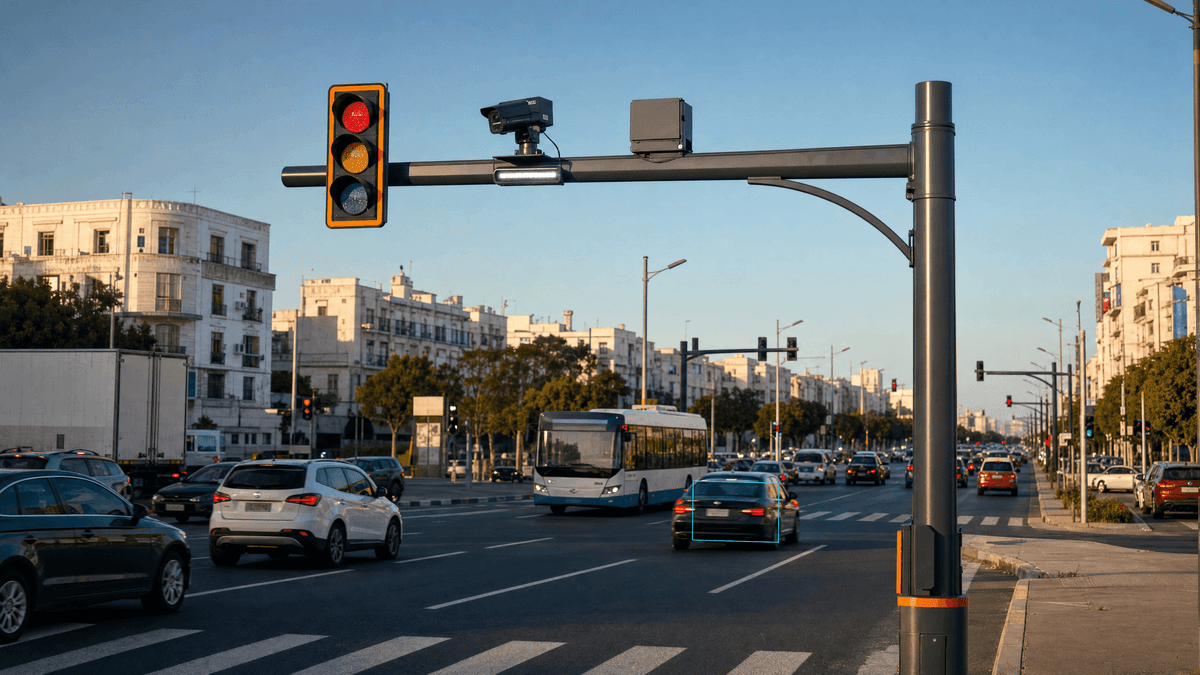
Algiers Smart Traffic System Market Analysis: 10-Intersection 6m L-Arm Configuration Guide
Summary
Algiers, a metro area of more than 3 million people, faces dense corridor congestion where sub-50ms edge response and 45-type detection can improve junction control. For a typical 10-intersection program, a 6m L-arm smart pole layout with 5G/fiber backhaul is a technically suitable fit.
Key Takeaways
- A typical Algiers deployment of this profile would cover 10 intersections using 6m dark-grey hot-dip galvanized L-arm steel poles sized for urban junctions rather than highway gantries.
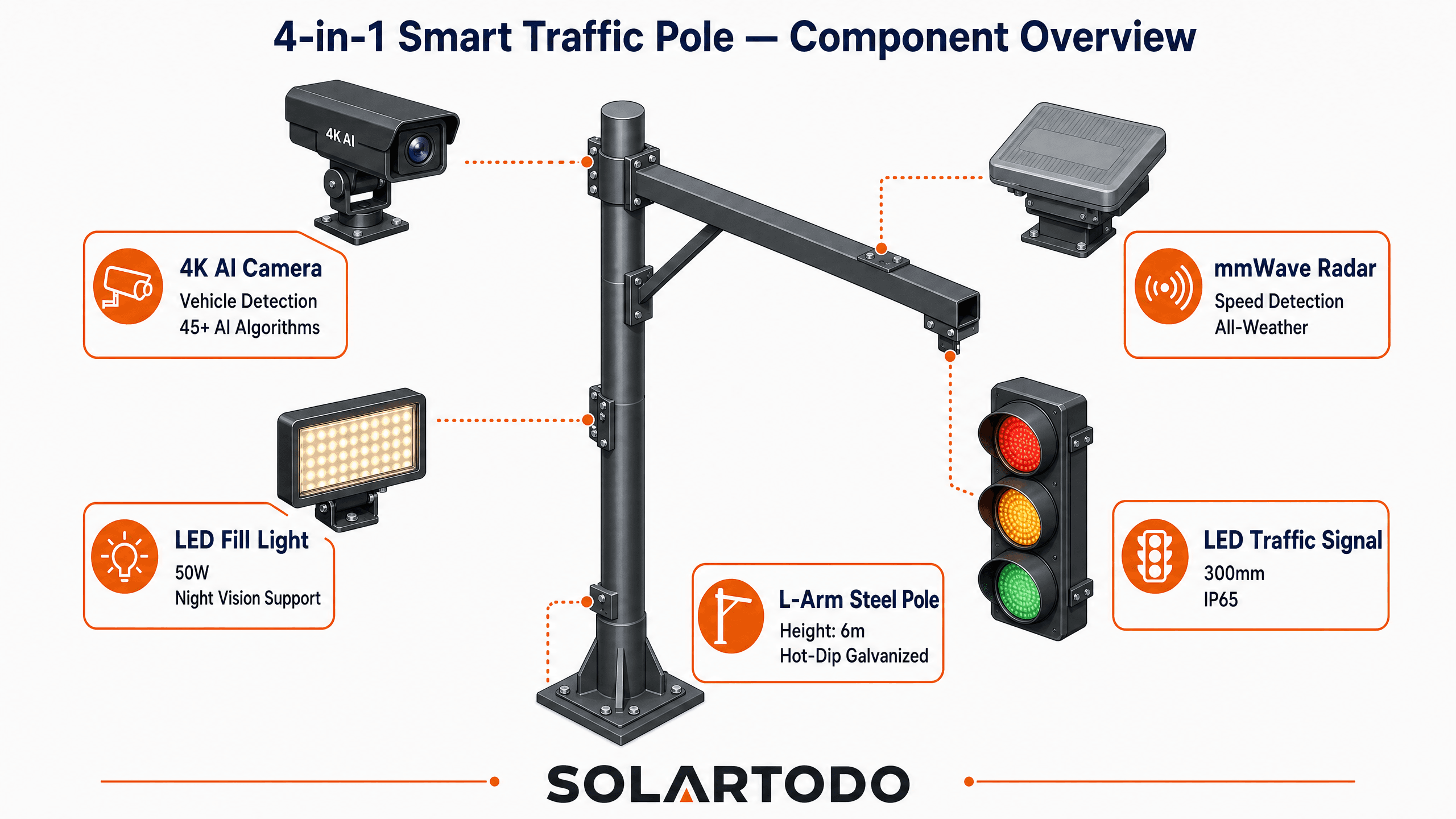
- Each pole would combine 4 modules in 1 structure: 4K AI camera, 77GHz mmWave radar, LED fill light, and LED signal head with NVIDIA Jetson edge AI.
- Detection performance is specified at 98% accuracy, supports 45+ object/event types, and responds in under 50ms, which suits adaptive signal control in dense urban traffic.
- A typical junction would require 4-12 poles per intersection; for this article's target profile, the recommended planning basis is approximately 1 pole per approach plus auxiliaries within a 10-intersection package.
- Communications should support 5G and fiber backhaul to a central TrafficGPT platform, enabling natural-language traffic queries and corridor-level signal optimization.
- Functional priorities for Algiers should include adaptive signal control, emergency vehicle priority, wrong-way alert, and full 45-type detection at arterial intersections.
- The recommended commercial structure for this city profile is Joint Venture, which can align municipal right-of-way control, local civil works, and phased digital traffic upgrades.
- Compliance should be checked against NTCIP for traffic communications and GB 25280 for road traffic signal controller-related requirements, alongside applicable Algerian civil, electrical, and telecom rules.
Market Context for Algiers
Algiers combines a population above 3 million, a Mediterranean coastal climate, and concentrated commuter demand that makes intersection intelligence more valuable than isolated signal upgrades. According to the World Bank (2023), Algeria remains highly urbanized, with urban population share above 70%, while the National Office of Statistics of Algeria reports Algiers as the country's largest metropolitan concentration, which increases peak-hour pressure on arterial roads.
The city also has transport complexity beyond private vehicles. Algiers includes port logistics, airport access, dense municipal bus movements, and radial commuter flows from eastern and western suburbs. According to the International Transport Forum/OECD regional mobility assessments for North Africa, congestion costs in large metropolitan areas rise when signal plans are fixed rather than adaptive. In practical terms, a junction that processes mixed flows of cars, buses, motorcycles, pedestrians, and emergency vehicles benefits from multi-sensor detection rather than camera-only counting.
Climate matters for pole and enclosure selection. According to Climate-Data.org and World Bank Climate Knowledge Portal datasets, Algiers has mild wet winters, dry summers, and marine corrosion exposure due to its coastal position near 36.75, 3.04. That supports the use of hot-dip galvanized steel and dark-grey finishing for a longer maintenance cycle in salt-laden air. A 6m urban L-arm form is generally more suitable than 10-12m highway variants because inner-city signal visibility and sensor line-of-sight can be achieved without oversizing the structure.
Telecom readiness is also favorable. According to the ITU (2023), mobile broadband coverage in MENA urban centers is high, and municipal ITS programs increasingly rely on hybrid communications using fiber where available and cellular where trenching is constrained. For Algiers, that means a smart traffic architecture should support 5G/fiber backhaul rather than depend on one channel only. The result is better uptime for edge-to-center data transmission, especially for AI event alerts and adaptive signal timing updates.
Authority guidance also supports digital traffic control. The U.S. FHWA states, "Adaptive signal control technologies adjust the timing of traffic signals to accommodate changing traffic patterns and ease traffic congestion." That principle is directly relevant to Algiers because fixed-time plans often underperform where peak demand changes by corridor, season, and incident conditions. Likewise, NEMA notes in guidance on traffic management communications that interoperable controller communications reduce integration risk when agencies expand intersection networks over time.
For buyers evaluating suppliers, the local fit question is not whether Algiers needs smart traffic in general, but which pole class and sensor stack best match its urban geometry. Based on the product rules provided here, Algiers aligns with the single 6m urban intersection pole class for a 10-intersection package, not a tall gantry or highway-only configuration. That makes the SOLAR TODO Smart Traffic System relevant as a compact roadside platform rather than a large corridor gantry system.
Recommended Technical Configuration
For a 10-intersection Algiers program, the most suitable configuration is approximately 10 sets of 6m L-arm hot-dip galvanized steel poles with 4-in-1 sensing, edge AI, and 5G/fiber links to a central TrafficGPT platform.
A typical deployment in this city profile would prioritize urban intersections with heavy turning movements, bus interference, pedestrian crossings, and emergency access routes. The specified package is 10 intersections × 6m L-arm steel pole in dark grey, fabricated from hot-dip galvanized steel for corrosion resistance in coastal conditions. This is the correct size class because the product definition states 6/8/10m variants should rotate by intersection size and signal mounting need, while 10-12m is reserved for highway gantries.
For Algiers, the recommended sensing stack should remain exactly as specified: 4K AI camera, 77GHz mmWave radar, LED fill light, and LED signal head on one pole, with NVIDIA Jetson edge AI. This combination is stronger than camera-only systems in fog, glare, and night conditions because radar maintains object tracking when optical contrast drops. According to the FHWA (2022), multimodal detection improves signal timing quality where vulnerable road users and turning vehicles share the same space.
A typical 10-intersection deployment of this scale would support these functions:
- Full 45-type detection for vehicles, pedestrians, cyclists, stopped objects, queue conditions, and selected incident patterns
- Adaptive signal control based on live lane demand rather than fixed cycle assumptions
- Emergency vehicle priority to reduce response delay on key municipal routes
- Wrong-way alert for high-risk approaches, slip roads, or channelized urban entries
- Natural-language queries through the TrafficGPT central platform for operator use
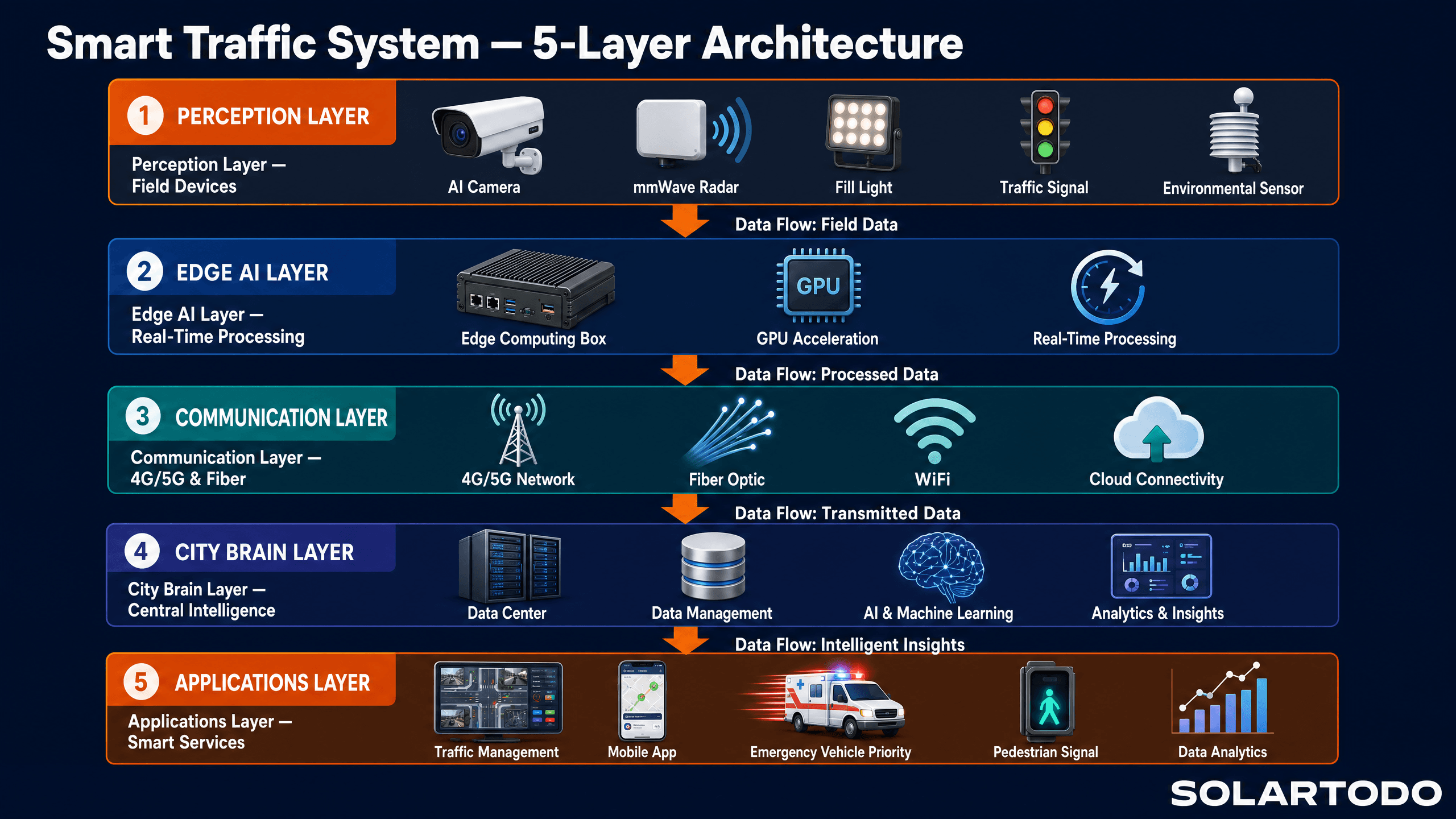
The communications layer should connect edge devices to the center using fiber where ducts exist and 5G where civil work should be minimized. The product architecture follows a 5-layer stack: Perception → Edge AI → Communication → City Brain (TrafficGPT) → Applications. That structure is useful in Algiers because it reduces the amount of raw video that must travel to the center. Instead, the NVIDIA Jetson layer can process events locally and send metadata or alerts upstream, which lowers bandwidth demand and improves response time.
The commercial model specified for this article is Joint Venture. In Algiers, that model can fit projects where municipal agencies control intersections, local contractors manage foundations and ducting, and the technology provider supplies poles, sensing equipment, edge AI, and integration. SOLAR TODO can therefore be positioned in procurement discussions as a technology and engineering partner within a shared delivery structure, not as a contractor making unsupported claims of prior deployment.
For procurement teams comparing options, the main selection logic is simple. A 6m L-arm pole is appropriate for dense urban crossroads. An 8m or 10m pole would be considered only if mast-arm geometry, lane width, or mounting clearance requires it. Since the project-specific brief fixes the design at 6m, the recommendation should stay with that dimension across the 10 intersections unless a detailed sightline survey identifies exceptions.
Technical Specifications
The specified Algiers configuration is a 10-intersection package using 6m L-arm smart poles with 4-in-1 sensing, sub-50ms edge response, and NTCIP/GB 25280 compliance targets.
- Deployment basis: 10 intersections
- Pole type: L-arm steel pole
- Pole height: 6m
- Pole finish: dark grey
- Corrosion protection: hot-dip galvanized steel
- Integrated modules: 4K AI camera + 77GHz mmWave radar + LED fill light + LED signal head
- AI edge hardware: NVIDIA Jetson
- Detection capability: full 45-type detection
- Detection accuracy: 98%
- System response time: <50ms
- Traffic functions: adaptive signal control, emergency vehicle priority, wrong-way alert
- Backhaul: 5G/fiber
- Central platform: TrafficGPT with natural-language queries
- Cooperation model: Joint Venture
- Standards referenced: NTCIP, GB 25280
- Typical pole count guidance: 4-12 poles per intersection depending on approach count and auxiliary coverage
- Recommended use case: urban crossroads and arterial intersections, not 10-12m highway gantries
From a standards perspective, NTCIP matters because it supports controller and device communications across mixed ITS environments. GB 25280 is relevant because it addresses road traffic signal controller requirements often referenced by manufacturers supplying integrated signal systems. For civil and structural review in Algeria, buyers should also verify local wind loading, foundation design, earthing, and road authority approvals before final IFC drawings are issued.
Implementation Approach
A practical Algiers rollout would proceed in 4 phases over roughly 16-28 weeks, starting with site survey and communications checks, then civil works, pole installation, and finally signal and AI commissioning.
Phase 1 is corridor assessment and design. This usually takes 2-4 weeks for 10 intersections if base maps, duct records, and signal plans are available. The work should include approach geometry measurement, controller cabinet review, power availability check, fiber route confirmation, and a line-of-sight study for the 4K camera and 77GHz radar. At this step, the buyer should also decide which intersections need emergency priority logic and whether wrong-way alerts are relevant on channelized entries.
Phase 2 is manufacturing, procurement, and logistics. For a 10-intersection package, fabrication of 6m hot-dip galvanized L-arm poles and assembly of edge AI equipment may run 4-8 weeks, depending on controller interface requirements and customs lead times. If the project uses a Joint Venture structure, local partners typically handle permits, trenching, and utility coordination while SOLAR TODO supplies the integrated smart pole package and technical documentation.
Phase 3 is civil and electrical installation. A typical sequence includes foundation excavation, anchor cage placement, conduit installation, earthing, cabinet adaptation, pole erection, and device mounting. For urban intersections, field work often takes 2-5 days per junction, provided lane closures are approved and underground conflicts are limited. Coastal conditions in Algiers make grounding, surge protection, and corrosion control especially important.
Phase 4 is software integration and commissioning. This generally takes 2-4 weeks for 10 intersections, covering sensor calibration, event classification validation, signal priority rule setup, and TrafficGPT dashboard configuration. According to the FHWA (2023), adaptive systems perform best when agencies validate detector placement and timing logic with real traffic observations rather than relying only on design assumptions.
Operationally, the system should be accepted against measurable KPIs. Examples include <50ms edge response, stable event transmission over 5G/fiber, verified emergency pre-emption logic, and accurate wrong-way alerts under day and night conditions. A buyer should also request acceptance tests for camera/radar fusion, fail-safe signal behavior, and local fallback operation if the center link is interrupted.
Expected Performance & ROI
For dense Algiers intersections, a 10-junction smart traffic package would typically target 10-25% delay reduction, faster incident recognition, and lower field maintenance visits through edge diagnostics and centralized monitoring.
According to the U.S. FHWA (2022), adaptive signal control can reduce travel time by more than 10% in suitable corridors, with some deployments showing larger gains where traffic demand changes substantially by time of day. That benchmark should be treated as directional rather than guaranteed, but it is useful for Algiers because fixed-time urban signals often struggle with variable commuter peaks. A 10-intersection program can therefore be justified if corridor congestion, bus delay, and emergency response routes already create measurable social cost.
Maintenance economics also favor integrated poles over fragmented roadside devices. A single 4-in-1 pole reduces separate brackets, cabinets, and alignment tasks compared with installing camera, radar, lighting, and signal hardware as standalone assets. According to IEA digital infrastructure assessments (2023), edge processing lowers upstream data loads and can reduce recurring communication and central compute requirements. In practical terms, the NVIDIA Jetson layer helps by filtering events locally before sending them to TrafficGPT.
The ROI case in Algiers should be built from four value streams:
- Reduced average delay at target junctions
- Lower incident response time from wrong-way and stopped-object alerts
- Emergency vehicle time savings on selected routes
- Lower maintenance dispatch frequency through centralized diagnostics
Payback often depends on labor cost, congestion cost, and whether fiber already exists. For a municipal buyer with severe peak-hour delay, a smart traffic package may show a planning-level payback in 3-6 years if travel time savings and reduced manual traffic management are monetized. Where civil works are heavy and communications must be newly built, payback may extend toward 6-8 years. These are planning ranges, not guaranteed returns, and should be validated with local traffic counts and cost of delay assumptions.
The World Bank states that efficient urban mobility supports productivity by reducing time lost in congestion and improving access to jobs and services. That statement is directly relevant to Algiers because intersection bottlenecks compound across corridors. For that reason, SOLAR TODO should be evaluated not only on equipment price, but also on whether its 98% detection accuracy, <50ms response, and 5G/fiber architecture can support sustained network operations at 10 intersections and beyond.
Results and Impact
For Algiers, the main expected impact is better intersection control at 10 urban junctions through 45-type detection, sub-50ms local processing, and coordinated 5G/fiber data flow into TrafficGPT.
The operational result of this architecture is not simply more video. It is more usable traffic intelligence at the signal phase level. A 4K camera identifies classes and events, the 77GHz radar adds range and motion confidence, and the NVIDIA Jetson device converts these inputs into real-time control data. That is the technical basis for adaptive timing, emergency priority, and wrong-way alerts at urban scale.
For Algiers authorities, the broader impact would likely be strongest on corridors with irregular demand. Port access roads, airport connectors, municipal bus routes, and dense commercial districts all produce lane-by-lane variation that fixed plans do not handle well. A 10-intersection package is therefore a practical first scale for measuring whether AI-assisted control improves queue balance, clearance times, and operator visibility before wider rollout.
SOLAR TODO also fits a phased procurement path. A municipality could start with approximately 10 intersections, validate KPIs, and then extend the same architecture to 20 or 50 intersections without changing the core stack of perception, edge AI, communications, and center software. For buyers comparing systems, that scalability matters more than isolated hardware features.
Comparison Table
The table below compares the recommended Algiers configuration against common alternatives used in urban traffic upgrades.
| Configuration | Pole Height | Sensors | Edge Processing | Communications | Best Use | Limits |
|---|---|---|---|---|---|---|
| Recommended SOLAR TODO Smart Traffic System | 6m | 4K AI camera + 77GHz radar + LED fill light + LED signal | NVIDIA Jetson, <50ms | 5G/fiber | Dense urban intersections in Algiers | Requires controller integration and site survey |
| Camera-only smart pole | 6m | 4K/1080p camera only | Basic or central-only | 4G/fiber | Low-cost counting and video review | Lower reliability in glare, fog, and poor night contrast |
| Traditional fixed-time signal pole | 6m | Loop or push-button only | None | Limited | Simple intersections with stable demand | No 45-type detection, no adaptive control |
| Highway gantry system | 10-12m | Multi-lane camera/radar array | Edge + central | Fiber preferred | Expressways and high-speed corridors | Oversized for most city-center junctions |
Pricing & Quotation
SOLAR TODO offers three pricing tiers for this product line: FOB Supply (equipment ex-works China), CIF Delivered (including ocean freight and insurance), and EPC Turnkey (fully installed, commissioned, with 1-year warranty). Volume discounts are available for large-scale deployments. Configure your system online for an instant estimate, or request a custom quotation from our engineering team at [email protected].
Frequently Asked Questions
This FAQ answers 10 common buyer questions on specifications, installation, pricing structure, maintenance, ROI, and standards for a 10-intersection Smart Traffic System in Algiers.
Q1: Why is a 6m pole recommended for Algiers instead of 8m or 10m?
A 6m L-arm pole matches typical urban intersection geometry where signal heads and sensors need clear visibility without highway-level mounting height. The product rules reserve 10-12m variants for gantries and expressway use. In Algiers, most city junctions can achieve camera and radar coverage with 6m, provided a site survey confirms line of sight.
Q2: What exactly is included in the 4-in-1 Smart Traffic System pole?
Each specified pole includes 1× 4K AI camera, 1× 77GHz mmWave radar, 1× LED fill light, and 1× LED signal head on a single 6m hot-dip galvanized L-arm structure. Edge processing runs on NVIDIA Jetson, and the system supports 45-type detection, adaptive signal control, emergency priority, and wrong-way alert.
Q3: How many poles would 10 intersections usually require?
The general product guidance is 4-12 poles per intersection, depending on approach count, turning lanes, medians, and auxiliary detection needs. For planning, buyers should treat this article's scope as a 10-intersection package using the specified 6m pole type, then finalize exact counts after traffic engineering review and sightline validation.
Q4: How long would deployment usually take in Algiers?
A realistic range is 16-28 weeks for 10 intersections, including 2-4 weeks of survey/design, 4-8 weeks of manufacturing and logistics, 4-10 weeks of civil/electrical works, and 2-4 weeks of software commissioning. Timing depends on permits, trenching complexity, and whether fiber is already available at each junction.
Q5: What performance can buyers expect from the detection system?
The specified system is rated for 98% detection accuracy with under 50ms response time and support for 45+ detection types. Actual field performance still depends on mounting position, occlusion, weather, and controller integration quality. The addition of 77GHz radar improves consistency in low-light or reduced-contrast conditions compared with camera-only setups.
Q6: What is the likely ROI or payback period?
For municipal traffic upgrades, planning-level payback often falls in the 3-6 year range where congestion costs are high and civil works are moderate. If trenching, cabinet replacement, or new communications links are extensive, payback may move toward 6-8 years. A proper model should quantify delay savings, incident reduction, and maintenance savings at each of the 10 intersections.
Q7: How does this compare with a standard EPC traffic signal upgrade?
A standard EPC signal upgrade often replaces poles, heads, and controllers but may not include 4K AI, 77GHz radar, or NVIDIA Jetson edge analytics. The SOLAR TODO Smart Traffic System adds adaptive control inputs, wrong-way alerts, and richer event data. That usually raises initial scope but improves long-term operational visibility and corridor management.
Q8: What maintenance regime is typical for this system?
Most operators should plan quarterly visual inspections, semiannual cleaning and alignment checks, and annual validation of detector zones, controller logic, and surge protection. In coastal Algiers, galvanization condition, grounding integrity, and connector sealing deserve close attention. Central diagnostics can reduce emergency site visits by identifying communication or sensor faults early.
Q9: What warranty and support terms should buyers request?
The pricing section specifies 1-year warranty for EPC Turnkey supply. For larger municipal programs, buyers usually request optional extensions covering edge devices, communications hardware, and spare parts availability for 3-5 years. Support scope should clearly define response times, software update policy, and whether on-site commissioning assistance is included.
Q10: Can the system work if fiber is unavailable at some intersections?
Yes. The specified architecture supports 5G/fiber backhaul, so a mixed communications design is feasible. Fiber is usually preferred for stable high-capacity links, while 5G can reduce civil work where trenching is difficult. For Algiers, many buyers will choose fiber on major corridors and 5G on secondary junctions or early rollout phases.
References
- World Bank (2023): Algeria urban development and urban population indicators used to assess metropolitan traffic demand context.
- ITU (2023): ICT and mobile broadband development indicators relevant to 5G/fiber backhaul readiness in urban MENA markets.
- U.S. FHWA (2022): Adaptive Signal Control Technologies guidance noting measurable travel-time and delay improvements in suitable corridors.
- U.S. FHWA (2023): Traffic detector and signal operations guidance on calibration, validation, and deployment practices for adaptive systems.
- NEMA/NTCIP (2021): NTCIP communications framework for interoperable traffic signal and ITS device communications.
- Standardization Administration of China (GB 25280): Road traffic signal controller requirement framework relevant to integrated signal system compliance.
- World Bank Climate Change Knowledge Portal (2023): Climate baseline data for coastal Algeria relevant to corrosion exposure and environmental design considerations.
- Climate-Data.org (2023): Algiers climate profile supporting selection of hot-dip galvanized steel and urban roadside environmental protection measures.
For project-specific engineering support, buyers can review the Smart Traffic System product page or contact us for layout review, controller interface checks, and quotation support from SOLAR TODO.
Equipment Deployed
- 10 × 6m L-arm steel poles, dark grey, hot-dip galvanized
- 4K AI camera, 98% detection accuracy, <50ms response
- 77GHz mmWave radar for multi-object motion detection
- LED fill light integrated on pole assembly
- LED signal head integrated on pole assembly
- NVIDIA Jetson edge AI computing unit
- 5G/fiber backhaul interface to TrafficGPT central platform
- TrafficGPT platform access with natural-language query capability
- Adaptive signal control software functions
- Emergency vehicle priority function
- Wrong-way alert function
- NTCIP and GB 25280 compliance-oriented control interface