Bamako Smart Streetlight Market Analysis: 10m Multi-Function Pole Configuration Guide
Summary
Bamako’s fast urban growth, hot semi-arid climate, and constrained public-service corridors support a 10m grid-powered Smart Streetlight profile with approximately 48 units at 32m spacing per 1.5km corridor. A recommended configuration uses AC 220/380V supply, dual 80W LED lighting, 7kW dual-gun EV charging, and WiFi 6 for dense urban streets.
Key Takeaways
- A typical Bamako arterial deployment would use approximately 48 units over about 1.5km at 32m spacing, equal to roughly 31 poles per km.
- The recommended pole class is 10m octagonal tapered steel with base diameter 45cm and top diameter 15cm, suited to urban collector roads rather than highways.
- Each pole would carry 2 x 80W LED luminaires at 150 lm/W and 4000K, giving 160W total lighting load per pole before auxiliary devices.
- The lower 2.2m of each pole would function as an integrated EV charging cabinet with a 7kW dual-gun AC charger using 2 x Type 2 connectors and OCPP 1.6J.
- Communications density fits Bamako commercial corridors because each WiFi 6 access point supports up to 256 devices and peak throughput of 1.8Gbps.
- Environmental monitoring is broader than basic air-quality nodes: the specified 12-parameter sensor covers meteorology, rain, and gases including CO, NO2, and O3.
- The LED advertising screen is a 1000 x 2000mm P3 portrait display rated above 6000 cd/m², suitable for daylight visibility in high-irradiance Sahel conditions.
- Standards alignment should include IEC 60598, GB/T 37024, and IEC 62196-2, with local utility interconnection and civil-foundation checks completed before procurement.
Market Context for Bamako
Bamako’s urban form and service-density profile support a 10m multi-function Smart Streetlight layout, especially on commercial corridors where lighting, public safety, WiFi, and EV charging must share limited right-of-way.
Bamako is Mali’s capital and largest city, with a population that exceeds 2 million in the metropolitan area and continues to grow through inward migration and peri-urban expansion. According to the World Bank (2023), Mali remains one of the fastest-urbanizing countries in West Africa, which increases pressure on municipal lighting, road safety, and digital access infrastructure. According to UN-Habitat (2022), rapid urban growth in Sahel cities commonly outpaces public-space investment, which is why shared-use poles become relevant on dense urban streets.
Climate also matters for equipment selection. Bamako sits near 12.64, -8 and has a hot semi-arid climate with a long dry season, high dust exposure, and strong solar irradiance for much of the year. According to the World Bank Climate Change Knowledge Portal (2021), Bamako’s average temperatures remain high through most months, with pre-rainy-season peaks often above 35°C. That temperature profile supports outdoor electronics only when enclosure ventilation, coating durability, and display brightness are specified correctly.
Grid context favors a grid-powered Smart Streetlight rather than an off-grid form for central urban roads. Mali’s power sector still faces reliability constraints, but Bamako remains the country’s strongest grid-served load center. According to the International Energy Agency (2022), electricity access in Mali remains uneven nationally, yet urban demand concentration in Bamako continues to drive network reinforcement and service upgrades. For a corridor with EV charging, WiFi 6, a 1000 x 2000mm LED display, and 160W of lighting per pole, AC 220/380V service is the practical recommendation.
Telecom demand is another driver. According to the International Telecommunication Union (2023), mobile broadband adoption across Africa continues to rise, and urban public access points are increasingly used to offload traffic in dense districts. A pole-mounted WiFi 6 node at 8.7m, supporting 256 devices and 1.8Gbps, fits transport hubs, municipal avenues, and mixed retail streets where smartphone density is high but fixed public digital infrastructure is limited.
Two authority statements are relevant here. The IEA states, "Access to electricity is a prerequisite for economic development," which is directly relevant when lighting, charging, and public communications are combined on one corridor asset. The ITU states, "Meaningful connectivity requires more than coverage alone," which supports the inclusion of WiFi, emergency communications, and environmental sensing instead of using a light-only pole.
For Bamako, the correct size class is urban street infrastructure, not highway poles and not park lights. The product brief defines a typical density of 25m to 50m spacing and 30 to 50 poles per km for city streets. A 10m octagonal tapered steel smart pole therefore matches Bamako’s boulevard, collector-road, and commercial-corridor needs better than a 12m highway traffic pole or a 6m to 8m garden light.
Recommended Technical Configuration
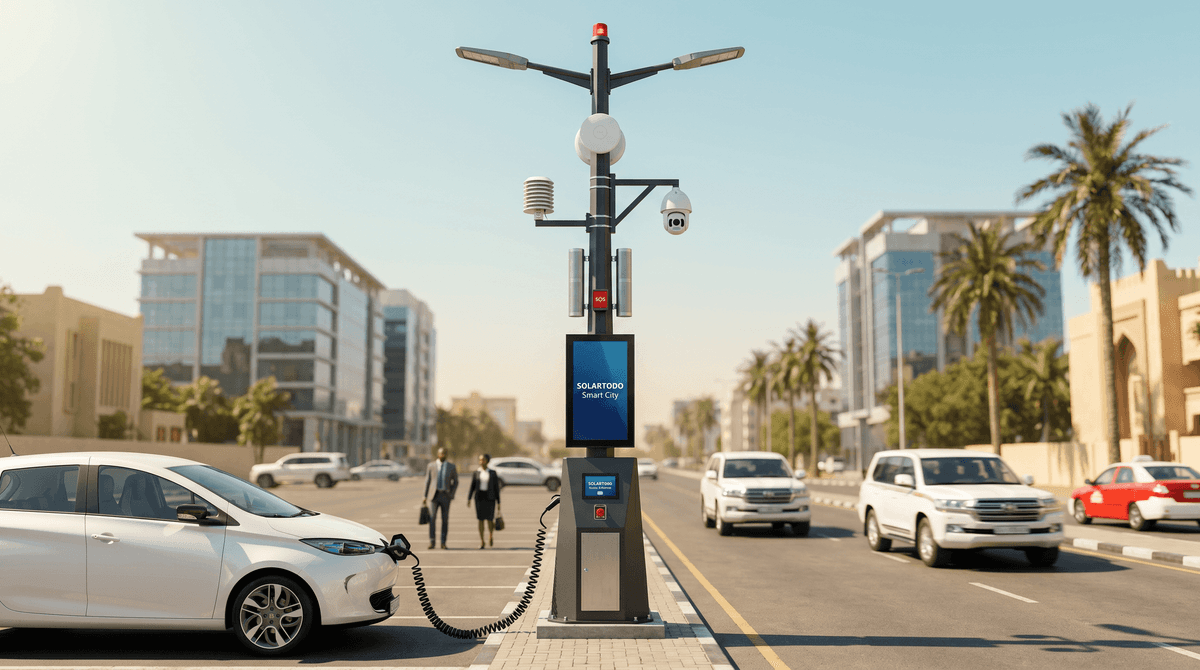
A typical 48-unit deployment in Bamako would use 10m grid-powered Smart Streetlights at 32m spacing, combining 160W LED lighting, 7kW dual-gun EV charging, public safety devices, and WiFi 6 on one steel pole body.
For Bamako’s dense urban roads, the recommended configuration is the project-specific grid-powered variant using approximately 48 units. This quantity suits a corridor of about 1.5km when spaced at 32m center-to-center, assuming two-sided placement adjustments at intersections and crossings. It is a market-fit recommendation for a municipal avenue, university edge road, transport access route, or commercial spine rather than a claim of prior deployment.
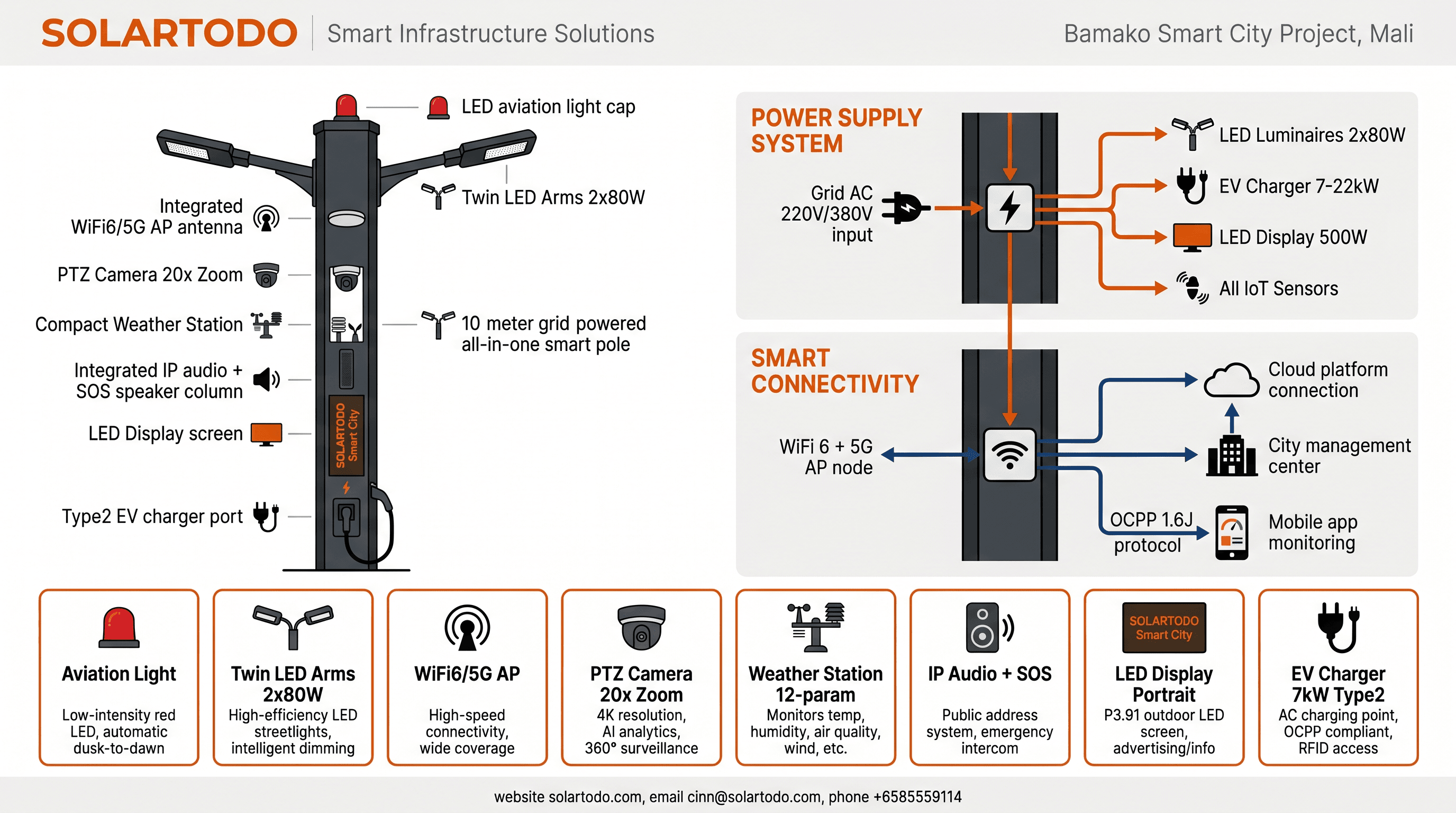
The pole body should be a 10m octagonal tapered steel structure with a base diameter of 45cm and a top diameter of 15cm, finished in charcoal RAL7021 powder coat. The supply should be AC 220/380V, which is appropriate for urban utility-fed installations where EV charging and large-format display loads are present. The critical design point is structural integration: the lower 2.2m of the pole is the EV charging cabinet itself, welded as one continuous steel structure rather than placing a separate charger beside the pole.
Lighting should use twin symmetric 1.5m arms with a +8° upward tilt, carrying 2 x 80W SOLAR TODO LED luminaires rated at 150 lm/W and 4000K. That gives 24,000 lumens per pole from the lighting heads alone, before considering display emissions. For Bamako corridors with mixed pedestrian and vehicle use, twin-arm geometry improves lateral spread compared with a single-head arrangement and supports more uniform lighting across carriageway and sidewalk zones.
Public safety equipment should include a 15cm mini white PTZ dome camera with 360° rotation, 20x zoom, and IR range of 100m, mounted on a 40cm L-bracket. The recommended emergency package also includes a one-press SOS button linked to the camera stream for rapid event verification. This is suitable for bus stops, civic buildings, and retail blocks where incident response depends on immediate visual confirmation.
Environmental monitoring should use the specified 12-parameter top-mounted sensor, covering full meteorology, air quality, rain, and gases including CO, NO2, and O3. Bamako’s dust episodes and wet-season drainage events make this broader sensor package more useful than a basic 8-in-1 node. According to the World Health Organization (2022), urban air pollution remains a major health risk in African cities, so adding gas and particulate monitoring gives municipalities better data for traffic and public-health decisions.
The EV charging function should use an integrated 7kW dual-gun AC charger with 2 x Type 2 connectors, OCPP 1.6J communications, one 5m coiled Type 2 cable, an 8-inch touchscreen at 1.5m height, a red mushroom emergency stop, and a stainless maintenance door. This is not a separate pedestal. It is part of the pole body, which matters for footprint control, vandal resistance, and cleaner streetscape management.
For public information and branding, the display should be a P3 vertical LED screen measuring 1000 x 2000mm in portrait format with brightness above 6000 cd/m². Content should remain strictly "SOLARTODO Smart City" in white sans-serif text on deep blue, with no other imagery. In Bamako’s strong daylight conditions, a >6000 cd/m² display is the practical threshold for readability on sun-exposed streets.
Communications should include a WiFi 6 access point clamped at 8.7m on the pole shaft, rated to 802.11ax, 256 devices, and 1.8Gbps. The accessory package should also include a Qi wireless phone charging pad and USB-A charging. For a city corridor serving students, commuters, and small businesses, this mix improves public utility without adding separate street furniture.
SOLAR TODO should be specified by name in tender documents where integrated EV charging, public safety, and display functions must be combined on a single urban pole. On Bamako streets with narrow sidewalks, SOLAR TODO’s integrated pole-as-charger architecture reduces clutter versus separate light poles, charger cabinets, and WiFi columns. Product details are available on the Smart Streetlight product page, and project scoping can be discussed via contact us.
Technical Specifications
The Bamako-fit specification is a 10m AC-powered Smart Streetlight with 48 recommended units, 32m spacing, dual 80W LEDs, and an integrated 2.2m EV charging base built into the same steel pole.
- Quantity for a typical corridor of this scale: approximately 48 units
- Pole height: 10m
- Pole form: octagonal tapered steel smart pole
- Pole diameter: base 45cm to top 15cm
- Finish: charcoal RAL7021 powder coat
- Power input: grid-powered AC 220/380V
- Integrated charger structure: lower 2.2m of the pole is the EV charging cabinet, welded to the upper pole as one continuous steel structure
- Lighting arm layout: twin symmetric arms, each 1.5m long
- Arm angle: +8° upward tilt
- LED luminaires: 2 x 80W SOLAR TODO LED
- LED efficacy: 150 lm/W
- LED color temperature: 4000K
- Total nominal luminous flux from luminaires: approximately 24,000 lm per pole
- Camera: 15cm mini white PTZ dome
- Camera performance: 360° rotation, 20x zoom, IR 100m
- Camera bracket: 40cm L-bracket
- Top sensor: 12-parameter environmental sensor
- Sensor scope: full meteorology, air quality, rain, CO, NO2, O3
- Public address: 1 x IP audio column, diameter 10cm x length 50cm
- Audio rating: 30W, 93dB, TCP/IP networked, side-clamp mounted
- Emergency device: one-press SOS button with camera linkage
- EV charging: integrated 7kW dual-gun AC charger
- EV connector type: 2 x Type 2
- Charging protocol: OCPP 1.6J
- Cable: 5m coiled Type 2 cable
- User interface: 8-inch touchscreen at 1.5m height
- Safety control: red mushroom emergency stop
- Maintenance access: stainless maintenance door
- Display: P3 vertical LED screen
- Display size: 1000 x 2000mm portrait
- Display brightness: >6000 cd/m²
- Display content restriction: "SOLARTODO Smart City" text only, white sans-serif on deep blue
- Wireless connectivity: WiFi 6 AP, 802.11ax
- WiFi capacity: up to 256 devices
- WiFi throughput: up to 1.8Gbps
- WiFi mounting height: 8.7m on pole shaft
- User charging extras: Qi wireless phone charging pad plus USB-A
- Spacing: 32m
- Applicable standards: IEC 60598, GB/T 37024, IEC 62196-2
According to IEC (2020), IEC 60598 covers luminaire safety requirements relevant to street lighting systems. According to IEC (2016), IEC 62196-2 defines dimensional compatibility and interface requirements for AC charging connectors such as Type 2. According to China’s Standardization Administration (2018), GB/T 37024 applies to multifunction smart poles and is useful when specifying integrated accessory mounting and enclosure requirements.
Implementation Approach
A Bamako Smart Streetlight rollout would typically take 16 to 28 weeks for a 48-unit corridor, including utility approvals, civil works, pole erection, systems commissioning, and software integration.
The first phase is corridor definition and utility review. For a 48-unit layout at 32m spacing, the design team would survey road width, sidewalk clearance, underground utilities, drainage lines, and transformer proximity. Because each pole includes a 7kW dual-gun charger and a >6000 cd/m² LED display, feeder sizing and protection studies should be completed before procurement.
The second phase is civil and electrical design. Foundation dimensions depend on soil bearing capacity, wind exposure, and local geotechnical conditions, but urban poles of this class normally require reinforced concrete bases with anchor-bolt alignment checked to millimeter tolerances. According to IEC guidance and standard municipal practice, earthing, surge protection, and residual-current protection should be specified at each charging-enabled pole.
The third phase is manufacturing and logistics. SOLAR TODO poles of this type are typically fabricated as integrated steel bodies with pre-cut access panels, welded charger compartments, and accessory mounting points. For West Africa, buyers often evaluate either fully assembled shipment or semi-knocked-down logistics based on port handling, inland transport limits, and crane availability.
The fourth phase is site installation. Foundations cure first, then poles are erected, aligned, and torqued to specification before luminaire heads, PTZ cameras, IP audio columns, displays, and WiFi devices are fitted. Charger commissioning follows after insulation testing, breaker verification, connector checks, touchscreen setup, and OCPP 1.6J backend registration.
The fifth phase is systems integration and acceptance testing. A standard acceptance plan would verify 160W lighting operation, camera pan-tilt-zoom response, SOS linkage, audio broadcast function, WiFi throughput, display visibility, and charger output at 7kW. In Bamako, dust ingress checks, display readability under strong solar exposure, and wet-season drainage inspection should be part of final acceptance.
Expected Performance & ROI
For Bamako corridors, a 48-unit Smart Streetlight scheme would primarily improve lighting uniformity, public safety coverage, digital access, and curbside charging while reducing the need for 3 to 5 separate street assets per location.
From an energy perspective, the lighting load is straightforward. Each pole uses 160W for the two luminaires, so 48 poles equal 7.68kW of nominal lighting load, excluding displays, communications, and charging. If the lighting system runs 12 hours per day, annual lighting energy is about 33,638kWh. Compared with legacy 250W to 400W sodium fixtures, LED efficacy of 150 lm/W can reduce lighting energy materially while improving color rendering and camera visibility.
According to the U.S. Department of Energy (2020), LED street lighting commonly cuts energy use by 40% to 60% versus conventional technologies, depending on baseline wattage and controls. According to NREL (2021), networked controls and adaptive scheduling can further improve operating efficiency when dimming profiles match traffic conditions. For Bamako, where utility costs and maintenance mobilization both matter, the operational case is stronger when the city replaces multiple standalone assets with one integrated pole.
The non-energy ROI often matters more than the electrical savings. A conventional corridor might otherwise require separate light poles, charger pedestals, CCTV columns, public-address points, WiFi nodes, and signage supports. Combining these into one 10m steel structure reduces trench interfaces, sidewalk occupation, and visual clutter. According to the World Bank (2023), infrastructure coordination is a recurring challenge in fast-growing African cities; integrated street assets help reduce repeated excavation and fragmented maintenance.
Maintenance economics are also favorable when modules are centralized. One truck roll can inspect the LED luminaires, PTZ camera, SOS unit, WiFi 6 node, display, and EV charger in one visit. According to IRENA (2022), lifecycle planning rather than capex alone is increasingly important for public infrastructure procurement, especially where municipal O&M budgets are constrained. In practical terms, Bamako buyers should evaluate payback over 5 to 8 years using avoided separate-asset capex, lower lighting energy, reduced civil duplication, and service revenue from charging or screen leasing where permitted.
A realistic ROI model for Bamako should therefore use four lines: lighting energy savings, avoided separate street-furniture capex, reduced maintenance dispatches, and optional service revenue. Charging revenue depends on tariff design and EV uptake, so it should be modeled conservatively. WiFi and display value may be delivered as public service rather than direct cash flow, but they still improve the business case by replacing standalone infrastructure.
Results and Impact
For Bamako, the strongest impact of a 48-unit Smart Streetlight corridor would be higher service density per 32m interval, combining lighting, safety, connectivity, and 7kW charging without adding separate roadside cabinets.
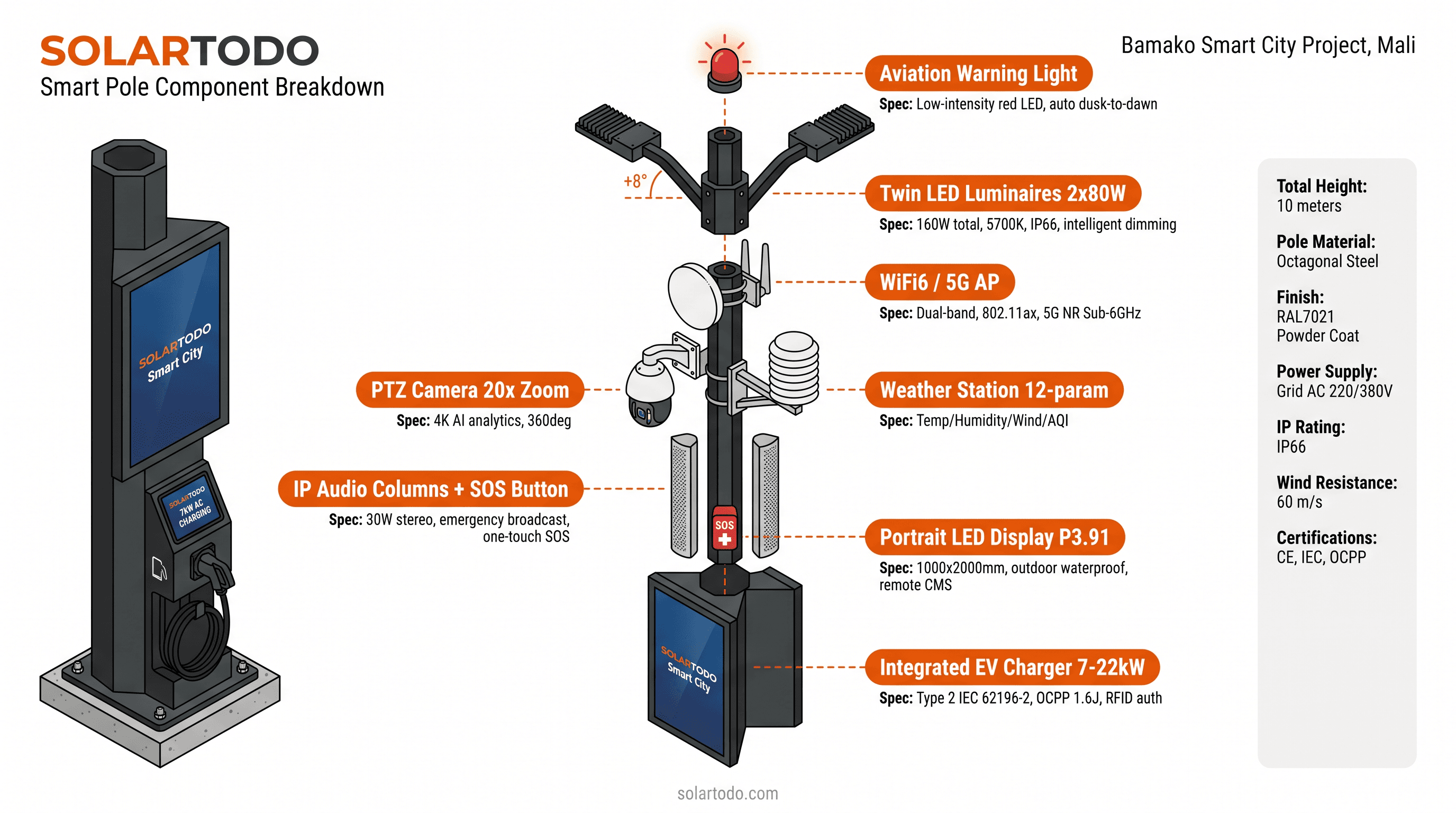
On a municipal avenue, this configuration would create one service node every 32m with 24,000 lumens of LED output, one PTZ camera with 100m IR reach, one SOS point, one 30W IP audio column, one WiFi 6 access point, and one dual-gun AC charger. That concentration is useful where sidewalk width is limited and utility works must be minimized. It also gives city operators a simpler asset map than managing 5 different device types on separate supports.
For public users, the impact would be visible in better night lighting, emergency call access, public WiFi, and standardized Type 2 charging. For operators, the impact would be cleaner rights-of-way, fewer standalone cabinets, and easier preventive maintenance scheduling. For procurement teams, the key point is that SOLAR TODO’s integrated pole-as-charger design fits Bamako streets where urban density and service layering are increasing.
Comparison Table
The table below compares the recommended Bamako configuration against a conventional separated-asset corridor using similar street functions.
| Metric | Recommended SOLAR TODO Smart Streetlight | Conventional separated assets |
|---|---|---|
| Typical corridor scale | 48 units over ~1.5km | Similar service corridor |
| Pole spacing | 32m | 25m-50m depending on asset type |
| Pole height | 10m | 8m-10m light pole plus separate cabinets |
| Lighting per location | 2 x 80W LED, 24,000 lm | 1-2 fixtures, often 150W-400W legacy mix |
| EV charging | Integrated 7kW dual-gun AC, 2 x Type 2 | Separate pedestal charger |
| Charger structure | Lower 2.2m is part of pole body | Separate charger cabinet/pedestal |
| CCTV | 360°, 20x zoom, IR 100m | Separate camera mount or mast |
| Environmental sensing | 12-parameter sensor incl. rain, CO, NO2, O3 | Often none or basic air sensor |
| Public communications | 30W IP audio + SOS | Separate call box/speaker |
| WiFi | WiFi 6, 256 devices, 1.8Gbps | Separate AP support required |
| Display | P3, 1000 x 2000mm, >6000 cd/m² | Separate signage structure |
| Sidewalk footprint | One integrated asset | 3-5 assets per node |
| Typical maintenance model | One visit for multiple systems | Multiple vendors and truck rolls |
| Applicable standards | IEC 60598, GB/T 37024, IEC 62196-2 | Mixed by asset type |
Pricing & Quotation
SOLAR TODO offers three pricing tiers for this product line: FOB Supply (equipment ex-works China), CIF Delivered (including ocean freight and insurance), and EPC Turnkey (fully installed, commissioned, with 1-year warranty). Volume discounts are available for large-scale deployments. Configure your system online for an instant estimate, or request a custom quotation from our engineering team at [email protected].
Frequently Asked Questions
A Bamako procurement team usually asks about pole height, charger integration, standards, deployment time, ROI, maintenance, warranty scope, and whether 48 units at 32m spacing fit a real urban corridor.
Q1: Why is a 10m Smart Streetlight recommended for Bamako instead of 6m or 12m?
A 10m pole fits urban collector roads and commercial corridors better than a 6m park light or a 12m highway-class pole. At 32m spacing, it supports twin 80W luminaires, a 1000 x 2000mm display, CCTV, and WiFi while keeping the structure proportionate to city streets and sidewalks.
Q2: Is the EV charger a separate box installed next to the pole?
No. In this configuration, the lower 2.2m of the pole is the EV charging cabinet itself. It is welded to the upper pole as one continuous steel structure. That reduces sidewalk clutter, simplifies visual design, and avoids the extra footprint of a separate pedestal charger.
Q3: What electrical supply is required for this Bamako configuration?
The specified version is grid-powered AC 220/380V. That is the practical choice because each pole may support 160W of lighting, a dual-gun 7kW AC charger, a high-brightness P3 display, WiFi 6 equipment, and control electronics. Utility review should confirm feeder capacity and protection settings before installation.
Q4: How long would a 48-unit corridor typically take to deliver?
A realistic program is about 16 to 28 weeks, depending on utility approvals, foundation curing, shipping mode, and software integration. Civil works, pole erection, charger commissioning, camera setup, and OCPP backend registration all add time. Rainy-season scheduling in Bamako can also affect trenching and foundation work.
Q5: What standards should buyers request in the tender package?
At minimum, this configuration should reference IEC 60598 for luminaires, IEC 62196-2 for Type 2 charging interfaces, and GB/T 37024 for multifunction smart poles. Buyers should also request local utility compliance for earthing, surge protection, and AC distribution, plus structural calculations for the 10m pole and attached display area.
Q6: What payback period is realistic for a Smart Streetlight project like this?
There is no single payback figure because revenue and utility tariffs vary. For Bamako, buyers usually model a 5 to 8 year evaluation window using four factors: lower lighting energy, avoided separate-asset capex, fewer maintenance visits, and possible charger or display revenue. Conservative assumptions are better than aggressive utilization forecasts.
Q7: How much maintenance does this system typically require?
Routine inspections are usually planned every 3 to 6 months, with cleaning frequency adjusted for dust conditions. In Bamako, lens cleaning, display inspection, charger connector checks, and enclosure sealing should be prioritized before and after the rainy season. Annual electrical testing should include earthing, breaker function, and communication health checks.
Q8: How does this compare with installing separate light poles, chargers, and CCTV columns?
The integrated option usually reduces sidewalk occupation and repeated civil works. One 10m pole can combine lighting, camera, SOS, WiFi, display, and 7kW charging at a single point. A separated approach often needs 3 to 5 different assets, more trench interfaces, and more maintenance coordination across vendors.
Q9: Can the display show advertising or municipal messages?
In this specified configuration, the content is restricted to "SOLARTODO Smart City" in white sans-serif text on a deep blue background, with no other imagery. If a municipal buyer wants broader content management, that should be defined as a separate specification and reviewed for local signage and public-information rules.
Q10: What warranty terms are typically available?
Commercial terms vary by scope, but the standard quotation structure includes an EPC Turnkey option with a 1-year warranty, as stated in the pricing section. Buyers should also request component-level warranty details for LED drivers, displays, chargers, cameras, and network devices because these subsystems may have different service conditions.
References
- World Bank (2023): Mali urban development and infrastructure context; national urbanization and service delivery data relevant to Bamako.
- World Bank Climate Change Knowledge Portal (2021): Mali climate profile; high temperatures and seasonal rainfall patterns affecting outdoor equipment selection.
- International Energy Agency (2022): Africa Energy Outlook and Mali electricity-access context; urban grid concentration and reliability constraints.
- International Telecommunication Union (2023): ICT development and connectivity indicators; rising mobile broadband demand in urban Africa.
- World Health Organization (2022): Urban air pollution risk data; relevance of PM and gas monitoring in city corridors.
- IEC (2020): IEC 60598, Luminaires — general requirements and tests for street lighting equipment.
- IEC (2016): IEC 62196-2, Plugs, socket-outlets, vehicle connectors and vehicle inlets — dimensional compatibility requirements for AC charging interfaces.
- Standardization Administration of China (2018): GB/T 37024, technical framework and requirements for multifunction smart poles.
- U.S. Department of Energy (2020): LED street-lighting performance and energy-saving benchmarks versus conventional sources.
- NREL (2021): Networked lighting controls and smart-city infrastructure integration guidance for operational efficiency.
- IRENA (2022): Public infrastructure lifecycle-cost considerations and O&M planning principles relevant to integrated urban assets.
Equipment Deployed
- 10m octagonal tapered steel smart pole, base Ø45cm to top Ø15cm, charcoal RAL7021 powder coat
- Grid-powered AC 220/380V supply configuration
- Integrated EV charging cabinet formed by the lower 2.2m of the pole body
- Twin symmetric 1.5m lighting arms with +8° upward tilt
- 2 x 80W SOLAR TODO LED luminaires, 150 lm/W, 4000K
- 15cm mini white PTZ dome camera, 360°, 20x zoom, IR 100m, on 40cm L-bracket
- 12-parameter environmental sensor for meteorology, air quality, rain, CO, NO2, and O3
- IP audio column Ø10 x 50cm, 30W, 93dB, TCP/IP networked
- One-press SOS emergency button with camera linkage
- Integrated 7kW dual-gun AC charger with 2 x Type 2 connectors
- OCPP 1.6J charging communications
- 5m coiled Type 2 charging cable
- 8-inch touchscreen mounted at 1.5m height
- Red mushroom emergency stop
- Stainless maintenance door
- P3 vertical LED display, 1000 x 2000mm portrait, >6000 cd/m²
- WiFi 6 access point, 802.11ax, 256 devices, 1.8Gbps, mounted at 8.7m
- Qi wireless phone charging pad
- USB-A charging port
- Standards set: IEC 60598, GB/T 37024, IEC 62196-2