Bridgetown Battery Energy Storage (BESS) Market Analysis: 300kWh / 75kW Emergency Backup Configuration Guide
Summary
Bridgetown’s compact commercial districts, hurricane-season resilience needs, and Barbados’ renewable electricity targets make a 300kWh / 75kW BESS a practical backup size for critical loads. A typical system would use 1×20ft containerized LFP storage, 97% round-trip efficiency, and IEC 62619 / UL 9540 compliance.
Key Takeaways
- Bridgetown sits in a small-island grid context where resilience matters: Barbados had a population of about 282,000 in 2023, concentrating commercial activity into a limited network footprint with high outage sensitivity, according to the World Bank (2024).
- Barbados targets 100% renewable electricity and carbon neutrality by 2030, according to the Government of Barbados and IRENA (2023), which increases the value of behind-the-meter storage for backup and grid support readiness.
- A recommended commercial configuration for Bridgetown is 300kWh / 75kW, using 1×20ft container, suited to emergency backup rather than daily cycling.
- The specified LFP Premium battery uses 97% round-trip efficiency, 95% DoD, 10,000-cycle life, 2%/year degradation, and a 20-year warranty.
- For monthly emergency testing at 0.05 cycles/day and 90% depth, the duty profile is light enough to prioritize uptime, safety systems, and long calendar life over high daily throughput.
- Safety and compliance should align with IEC 62619, UL 9540, and NFPA 855, with BMS supervision, forced-air cooling, and aerosol fire suppression integrated in the enclosure.
- A typical Bridgetown commercial backup application would support approximately 60-75kW of prioritized load for roughly 4 hours, depending on transfer strategy and reserve margin.
- SOLAR TODO should be evaluated as a supplier for containerized commercial BESS where buyers need clear scope definition, standards alignment, and quotation options through /products/energy-storage or contact us.
Market Context for Bridgetown
Bridgetown’s BESS demand is shaped by island-grid reliability requirements, dense commercial loads, and Barbados’ 2030 energy transition targets, making 300kWh / 75kW backup systems relevant for offices, retail, telecom support, and light industrial facilities.
Bridgetown is the capital and primary commercial center of Barbados, located near 13.1, -59.61 on a compact island system where generation, distribution, and imported fuel exposure affect power security. According to the World Bank (2024), Barbados’ population is approximately 282,000, and the country’s urban-commercial concentration means outages can affect a large share of business activity within a small geographic area. In a city with short feeder distances but limited redundancy compared with continental grids, backup duration of 2-4 hours often matters more than very high discharge power.
According to the Government of Barbados’ National Energy Policy and IRENA (2023), Barbados is pursuing 100% renewable electricity and carbon neutrality by 2030. That target changes the role of commercial storage. Battery systems in Bridgetown are not only standby assets; they also become part of a broader resilience strategy for facilities exposed to renewable intermittency, voltage disturbances, and storm-related interruptions. For buyers in hospitality, financial services, cold-chain retail, and municipal operations, a backup-focused BESS can reduce diesel runtime while maintaining critical circuits.
Climate is also a technical driver. Barbados sits in the Atlantic hurricane belt and faces high ambient temperatures, salt-laden air, and seasonal extreme weather. According to the World Bank Climate Change Knowledge Portal (2021), small island states in the Caribbean face increasing climate stress, including stronger storm risk and heat exposure. Those conditions support use of containerized systems with controlled airflow, corrosion-aware enclosure design, and fire protection that matches NFPA 855 spacing and installation practice.
Grid structure matters even when the application is behind the meter. Barbados Light & Power operates an island distribution network serving commercial and residential loads, and facilities in Bridgetown typically connect at low or medium voltage depending on building scale. For many urban commercial sites under 100kW critical load, a 75kW PCS fits practical backup use without oversizing transformer and switchgear packages. According to IEA (2023), battery storage is increasingly used to improve system flexibility and resilience in grids with rising renewable penetration, which aligns with Bridgetown’s policy direction.
Two authority statements are especially relevant here. IEA states, "Battery storage is one of the key technologies needed to accelerate the replacement of fossil fuels with clean energy" (IEA, 2024). NFPA states, "Energy storage systems shall be installed in accordance with this standard to reduce the risk of fire and explosion" (NFPA 855, 2023). In Bridgetown, those two points meet directly: storage must support cleaner power systems, but only with disciplined fire, ventilation, and site-planning controls.
For this reason, the best-fit size class is not a small wall-mounted cabinet and not a multi-container utility plant. Bridgetown’s typical commercial emergency-backup requirement fits the 500kWh-and-below commercial range, but the project-specific specification here uses 300kWh / 75kW in 1×20ft container. That enclosure choice is accepted because it is an exact supplied configuration for this product line, intended for commercial backup with integrated PCS and transformer package.
Recommended Technical Configuration
For a Bridgetown commercial facility needing about 60-75kW of protected load and 3-4 hours of autonomy, a typical deployment would use approximately 1 unit of 300kWh / 75kW containerized LFP BESS with transformer, PCS, and fire suppression.
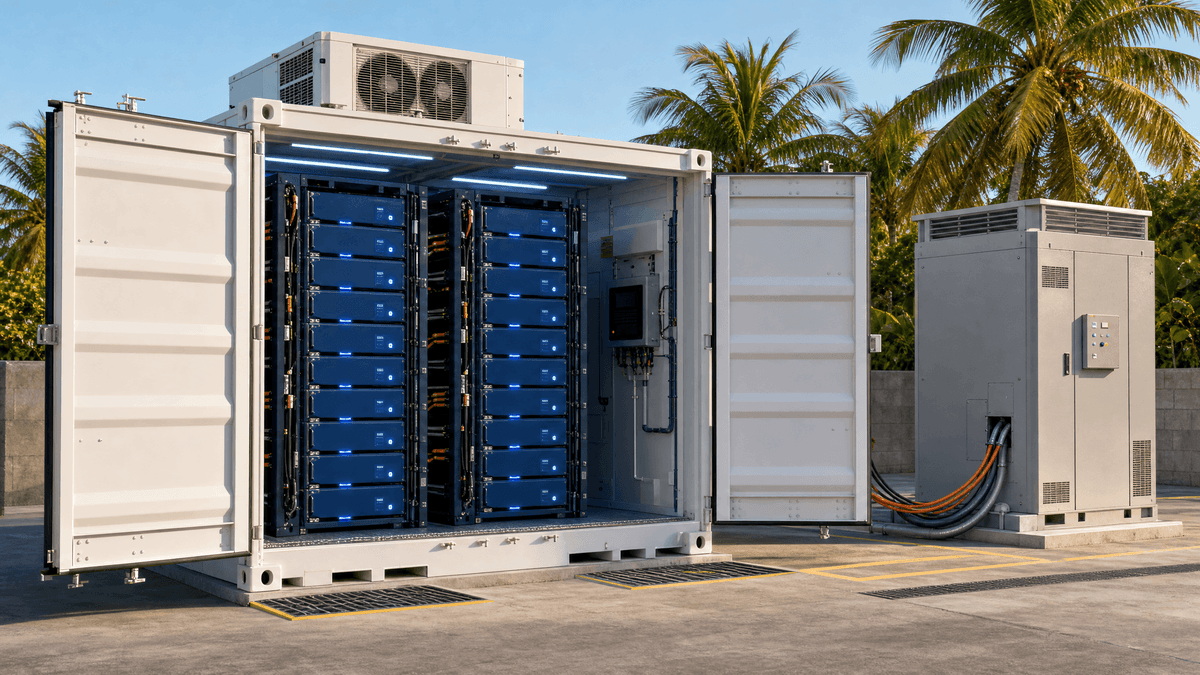
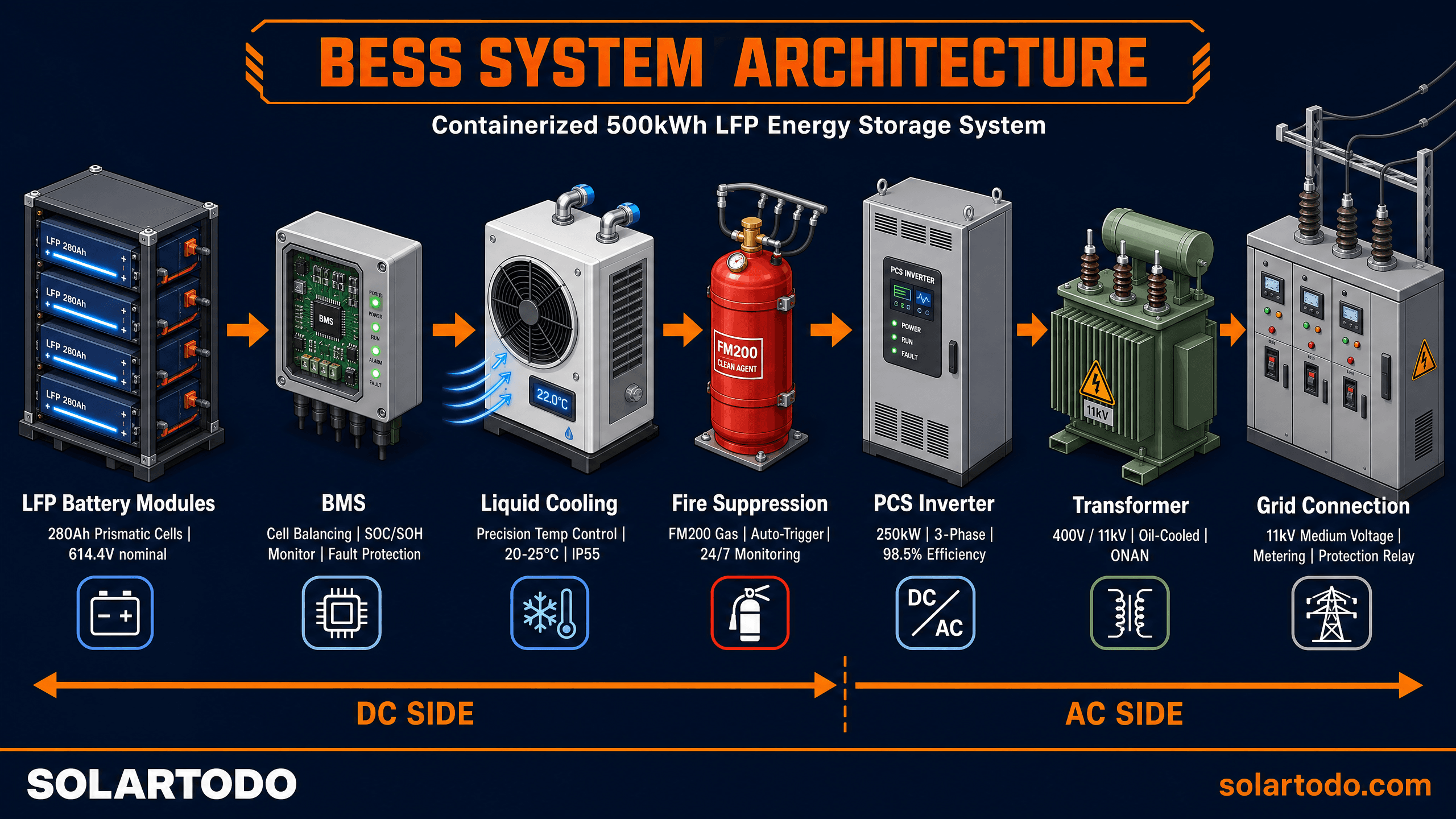
The recommended configuration for Bridgetown is based on emergency backup rather than daily arbitrage. A typical 1-unit deployment of this scale would consist of a 300kWh battery block, 75kW PCS inverter, 1×20ft container, integrated BMS, forced-air cooling, aerosol fire suppression, and step-up transformer. This matches urban commercial users such as supermarkets, clinics, office buildings, data rooms, and mixed-use properties where the goal is to protect critical circuits during utility interruptions.
The power-to-energy ratio of 75kW : 300kWh equals 0.25C, which is appropriate for moderate discharge rates and 4-hour backup windows. In practice, operators in Bridgetown would usually reserve 10-20% capacity margin to preserve emergency runtime and battery health during high-temperature periods. At 90% depth of discharge, usable backup energy is roughly 270kWh, which can support 67.5kW for about 4 hours or 75kW for about 3.6 hours, before accounting for auxiliary loads and inverter losses.
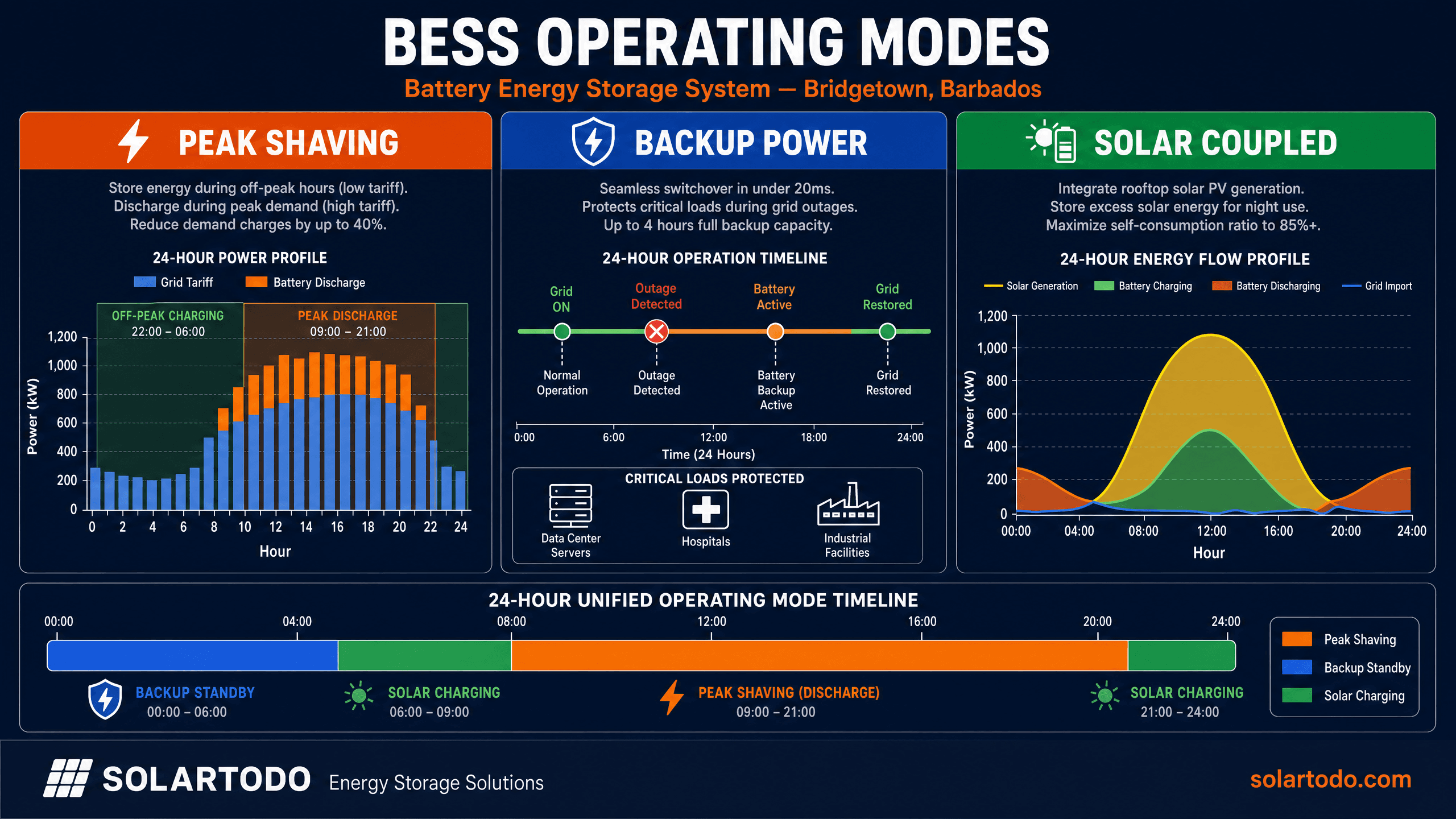
A typical deployment in Bridgetown would also include an automatic transfer scheme and critical-load segregation. Instead of backing up an entire building, the preferred approach is to isolate life-safety loads, IT racks, refrigeration, payment systems, security equipment, and selected HVAC zones. This keeps discharge within the 75kW continuous power envelope and reduces unnecessary battery cycling. SOLAR TODO can scope this configuration through its Battery Energy Storage product page or through a direct engineering inquiry via contact us.
For site planning, Bridgetown buyers should assume a hardened outdoor pad, cable trenching, earthing grid, and salt-air corrosion controls. NFPA 855 spacing and local fire authority review should be checked before final layout. Because this system is intended for monthly test cycle operation at 0.05 cycles/day, the commercial value comes from resilience and diesel displacement rather than high daily energy arbitrage. That changes the procurement logic: buyers should focus on protection architecture, transfer reliability, and warranty terms over simple kWh nameplate size.
Technical Specifications
This Bridgetown configuration centers on a 300kWh / 75kW commercial BESS in 1×20ft container, using LFP chemistry, 97% round-trip efficiency, 95% DoD, and compliance with IEC 62619, UL 9540, and NFPA 855.
- Product type: Commercial Battery Energy Storage (BESS)
- Application mode: Emergency backup power
- Nominal energy capacity: 300kWh
- PCS rated power: 75kW
- Container format: 1×20ft container
- Battery chemistry: LFP Premium (Lithium Iron Phosphate)
- Round-trip efficiency: 97%
- Depth of discharge: 95% DoD
- Cycle life: 10,000 cycles
- Expected degradation: 2% per year
- Warranty: 20 years
- Operating profile: Monthly test cycle, approximately 0.05 cycles/day
- Typical discharge depth in backup use: 90% depth
- Battery management: Integrated BMS
- Thermal management: Forced-air cooling
- Fire protection: Aerosol fire suppression
- Power conversion: Integrated PCS inverter
- Grid interface: Step-up transformer included
- Core standards: IEC 62619, UL 9540, NFPA 855
- Recommended site type: Commercial or light industrial facility with prioritized critical loads under 75kW
- Typical autonomy window: Approximately 3.5-4.0 hours at 67-75kW critical load, depending on reserve margin
According to IEC (2017), IEC 62619 sets safety requirements for secondary lithium cells and batteries used in industrial applications. According to UL (2020), UL 9540 covers energy storage systems and equipment safety as an integrated assembly. According to NFPA (2023), NFPA 855 provides installation requirements for stationary energy storage systems, including fire safety and siting considerations.
Implementation Approach
A Bridgetown BESS project of 300kWh / 75kW would typically be delivered over 12-20 weeks, covering engineering review, shipping, civil works, electrical integration, commissioning, and monthly-test programming.
The first phase is load study and single-line review. The facility should identify at least 30 days of interval load data, then separate critical circuits to keep emergency demand below 75kW. This step usually determines whether the BESS operates through an automatic transfer switch, a microgrid controller, or a dedicated backed-up panel. In Bridgetown, this review should also check utility interconnection rules and transformer voltage compatibility.
The second phase is site and civil preparation. A 20ft container normally requires a reinforced concrete pad, drainage planning, and access clearances for crane or forklift placement. In a coastal Caribbean setting, enclosure coating, earthing, and cable entry sealing need attention because salt exposure can shorten component life. Installers should verify wind exposure, flood risk, and fire separation distances before final placement.
The third phase is electrical integration. The 75kW PCS connects to the site distribution board through protection devices, metering, and the included step-up transformer where required. If the facility has an existing diesel generator, the BESS controls should define generator start logic, charging source priority, and no-backfeed conditions. For monthly testing at 0.05 cycles/day, programming should maintain the battery at a ready state rather than maximizing throughput.
The fourth phase is commissioning and acceptance testing. This normally includes insulation checks, communication tests, BMS alarm verification, HVAC operation, aerosol suppression checks, and a simulated outage test at 50-90% of critical load. Buyers should require records for charge-discharge validation, PCS synchronization, and emergency shutdown behavior. SOLAR TODO should provide a clear FAT/SAT scope so EPC teams and owners align on handover criteria.
The fifth phase is operations and maintenance planning. Backup-oriented BESS sites usually need monthly functional tests, quarterly visual inspections, and annual protection-system review. Because the cycle rate is low, calendar aging, thermal control, and auxiliary system health matter more than throughput wear. A Bridgetown operator should keep event logs, firmware records, and thermal trend data for the full 20-year warranty period.
Expected Performance & ROI
In Bridgetown, a 300kWh / 75kW backup BESS is expected to deliver about 270kWh usable emergency energy at 90% depth, with ROI driven mainly by outage-loss avoidance, diesel fuel reduction, and power continuity for revenue-critical loads.
For performance, the key number is usable backup energy rather than annual cycling revenue. At 300kWh nominal and 90% operating depth, the system provides approximately 270kWh of dischargeable energy. With 97% round-trip efficiency, charging losses remain low during monthly tests and standby conditioning. This is well suited to facilities where a 2-4 hour outage causes spoilage, transaction losses, tenant disruption, or service interruption.
For lifecycle, the specification is strong for a backup application. A 10,000-cycle battery at only 0.05 cycles/day is lightly used from a throughput perspective, so practical life is more likely governed by calendar aging and thermal conditions than by cycle exhaustion. Even with 2% annual degradation, a facility would still plan around resilience service across a long operating window, especially if critical loads are prioritized and reserve margins are maintained.
ROI in Bridgetown should be analyzed as avoided-cost resilience, not only simple energy arbitrage. According to NREL (2023), the value of battery storage depends heavily on stacked services and avoided outage costs. For commercial users such as food retail, pharmacies, financial branches, and telecom nodes, a single outage event can exceed the monthly carrying value of a backup asset if it interrupts transactions or damages temperature-sensitive stock. In those cases, payback can be acceptable even where daily cycling is minimal.
Diesel offset can further improve economics. According to IRENA (2019), battery storage can reduce generator runtime and improve system efficiency in islanded and weak-grid settings. In Bridgetown, a BESS can cover short outages instantly and reduce low-load generator operation, which is typically inefficient. The result is lower fuel use, less maintenance on gensets, and better power quality for electronics during transfer events.
A practical procurement model is to compare three scenarios over 10-20 years: diesel-only backup, diesel plus UPS, and BESS plus optional generator coordination. Buyers should include battery auxiliary consumption, replacement assumptions, warranty coverage, and outage cost per hour. SOLAR TODO’s commercial positioning is strongest where the owner values standards compliance, containerized integration, and documented backup runtime rather than only lowest first cost.
Results and Impact
For Bridgetown facilities with outage-sensitive operations, a 300kWh / 75kW BESS would typically improve backup continuity from seconds to roughly 4 hours while reducing diesel starts, voltage dips, and service interruption risk.
The main operational impact is continuity. Critical loads such as POS systems, server racks, refrigeration controls, lighting, and communications can remain energized without the transfer delay associated with generator-only systems. In a dense commercial district, that can protect hourly revenue, tenant confidence, and compliance-sensitive operations. For sites with existing generators, the BESS also improves ride-through and reduces nuisance shutdowns during short disturbances.
The second impact is maintenance and asset management. Monthly test cycling at 0.05 cycles/day places limited throughput stress on the battery, so operators can focus on inspection discipline, HVAC health, and alarm response. Compared with a generator-only strategy, the BESS reduces dependence on fuel logistics for short-duration events. In island markets where imported fuel costs and storm disruptions matter, that resilience value is material.
The third impact is alignment with Barbados’ energy policy direction. According to IRENA (2023), island systems benefit from flexible storage as renewable penetration rises. A backup BESS installed today for resilience can also support future control upgrades, demand management, or coordinated DER operation if interconnection rules evolve. That gives Bridgetown buyers a practical path to add flexibility without committing to a utility-scale architecture.
Comparison Table
For Bridgetown commercial buyers, the key comparison is between a 300kWh / 75kW backup BESS, a smaller cabinet system, and a diesel-only backup strategy across runtime, transfer quality, maintenance burden, and standards scope.
| Option | Rated Capacity / Power | Typical Use Case | Runtime at 60kW Critical Load | Transfer Quality | Maintenance Profile | Standards Focus |
|---|---|---|---|---|---|---|
| Recommended BESS | 300kWh / 75kW | Commercial emergency backup | ~4.5 h gross / ~4.0 h practical | Near-instant through PCS/controls | Monthly test + annual protection review | IEC 62619, UL 9540, NFPA 855 |
| Small cabinet BESS | 100kWh / 50kW | Small office / retail corner loads | ~1.5 h practical | Good for selected circuits only | Lower site complexity, shorter runtime | IEC 62619, UL 9540 |
| Diesel-only generator | Fuel-dependent / kW varies | Long-duration backup | Depends on fuel stock | Slower transfer unless paired with UPS | Fuel, oil, filters, mechanical service | NFPA / local genset codes |
| Hybrid BESS + diesel | 300kWh / 75kW + genset | High-resilience commercial site | 4 h battery + extended generator support | Best for ride-through and long outages | Highest integration complexity | IEC 62619, UL 9540, NFPA 855 |
Pricing & Quotation
SOLAR TODO offers three pricing tiers for this product line: FOB Supply (equipment ex-works China), CIF Delivered (including ocean freight and insurance), and EPC Turnkey (fully installed, commissioned, with 1-year warranty). Volume discounts are available for large-scale deployments. Configure your system online for an instant estimate, or request a custom quotation from our engineering team at [email protected].
Frequently Asked Questions
This FAQ answers the most common Bridgetown BESS buying questions, including specs, installation timing, maintenance, warranty, EPC scope, and expected backup performance for a 300kWh / 75kW commercial system.
Q1: What is the recommended BESS size for a commercial site in Bridgetown?
For many outage-sensitive commercial sites in Bridgetown, 300kWh / 75kW is a practical starting point when critical loads are kept below 75kW. That size usually supports 3.5-4.0 hours of backup at high-priority circuits. Final sizing should follow a load audit, transfer strategy review, and reserve-margin check.
Q2: Why use LFP chemistry instead of other lithium-ion types?
LFP is commonly selected for stationary storage because it offers strong thermal stability, long life, and good safety performance. This configuration specifies 10,000 cycles, 95% DoD, and 97% round-trip efficiency, which fits backup applications well. In Bridgetown’s warm climate, stable thermal behavior is an important procurement factor.
Q3: How long would installation typically take in Bridgetown?
A commercial 300kWh / 75kW project typically takes 12-20 weeks from engineering approval to commissioning, depending on shipping, utility review, and civil readiness. The on-site portion is shorter, often 1-3 weeks, if the concrete pad, trenching, switchgear interface, and access route are ready before equipment arrival.
Q4: Can this system replace a diesel generator entirely?
It can replace a generator for short outages if the critical load stays within 75kW and required runtime is around 4 hours. For longer outages, many Bridgetown sites would still keep a genset for extended autonomy. The strongest setup is often BESS for instant ride-through plus generator support for multi-hour or storm-related events.
Q5: What maintenance does this BESS require?
Maintenance is lighter than for a generator, but it is not zero. A typical plan includes monthly test cycles, quarterly visual checks, annual fire-system inspection, HVAC verification, and alarm log review. Because the duty profile is only 0.05 cycles/day, calendar aging, cooling performance, and enclosure condition matter more than heavy cycle wear.
Q6: What standards should Barbados buyers request in the tender?
For this product, buyers should request at minimum IEC 62619, UL 9540, and NFPA 855 alignment. Those standards cover battery safety, system-level certification, and stationary installation practice. Tender documents should also define site acceptance testing, emergency shutdown behavior, ventilation logic, and fire authority coordination before energization.
Q7: What is the expected payback period?
There is no single payback number because backup BESS economics depend on outage frequency, diesel costs, and the value of avoided downtime. In Bridgetown, ROI is often justified by business continuity rather than daily arbitrage alone. A proper model should compare outage-loss avoidance, generator runtime reduction, maintenance savings, and warranty-backed operating life over 10-20 years.
Q8: Does the 20-year warranty mean zero degradation?
No. The specification states 2% annual degradation, so capacity declines gradually over time. Buyers should plan critical-load coverage with margin rather than assuming full 300kWh for the entire service life. The warranty is valuable because it sets a contractual framework for long-term performance, but it does not eliminate normal aging.
Q9: Is a 20ft container appropriate for a 300kWh system?
Yes, for this exact product configuration it is the specified format: 1×20ft container with battery, PCS, cooling, suppression, and transformer integration. While smaller capacities can sometimes use cabinets, this commercial package is defined as containerized. That makes sense where buyers want outdoor installation, integrated auxiliaries, and simplified site delivery.
Q10: What should be included in an EPC quotation?
An EPC quote should separate equipment supply, shipping, civil works, electrical integration, commissioning, and warranty scope. It should also define the 75kW critical-load limit, switchgear modifications, transformer interface, SCADA or EMS communications, and NFPA 855 compliance responsibilities. Clear exclusions are as important as inclusions for commercial procurement.
References
- World Bank (2024): Barbados population and macro indicators showing an island market of approximately 282,000 people with concentrated infrastructure demand.
- Government of Barbados / National Energy Policy (2019): Policy framework targeting 100% renewable electricity and carbon neutrality by 2030.
- IRENA (2023): Caribbean and island energy transition analysis supporting storage adoption for flexibility and resilience.
- IEA (2024): Battery storage role in clean power systems and grid flexibility; includes the statement, "Battery storage is one of the key technologies needed to accelerate the replacement of fossil fuels with clean energy."
- IEC (2017): IEC 62619 safety requirements for secondary lithium cells and batteries for industrial applications.
- UL (2020): UL 9540 standard for energy storage systems and equipment.
- NFPA (2023): NFPA 855 standard for the installation of stationary energy storage systems, including fire and siting requirements.
- NREL (2023): Storage valuation guidance showing that project economics depend on stacked services, avoided outage costs, and operating strategy.
- World Bank Climate Change Knowledge Portal (2021): Caribbean climate risk context relevant to Bridgetown siting, heat, and storm resilience planning.
Equipment Deployed
- 300kWh commercial Battery Energy Storage (BESS)
- 75kW PCS inverter
- 1×20ft containerized enclosure
- LFP Premium battery, 97% round-trip efficiency
- 95% depth of discharge battery configuration
- 10,000-cycle battery life specification
- 2% per year degradation profile
- 20-year warranty package
- Integrated BMS
- Forced-air cooling system
- Aerosol fire suppression system
- Step-up transformer
- Compliance set: IEC 62619, UL 9540, NFPA 855