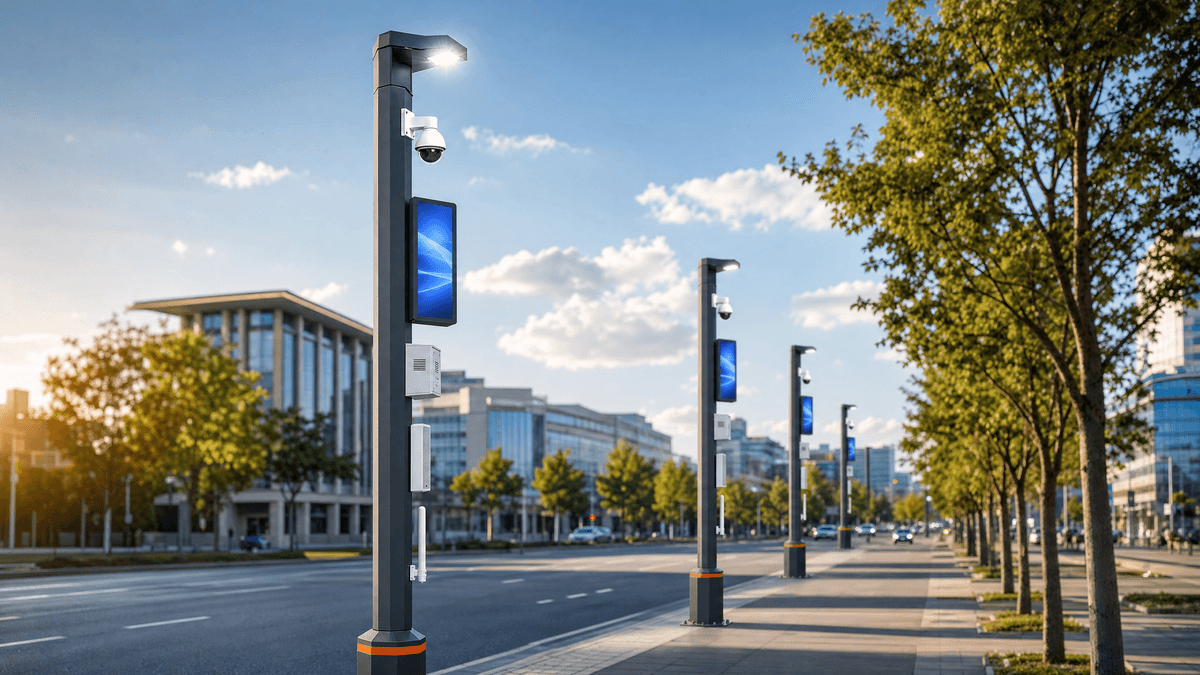
Concepción Smart Streetlight Technical Fit: 10m Multi-Function Pole Configuration Guide
Summary
Concepción’s dense urban corridors, coastal humidity, and public-safety monitoring needs indicate a typical 277-unit Smart Streetlight layout using 10m galvanized poles, 150W LED luminaires, and 30m spacing across 16m roads, with about 40% energy savings versus 250W HPS.
Key Takeaways
A typical Concepción Smart Streetlight program of this scale would center on approximately 277 units, each using a 10m octagonal hot-dip galvanized steel pole for arterial and collector roads rather than park or highway classes.
- A recommended road profile is 16m carriageway width with 30m pole spacing, which typically equals about 33 poles per km and fits the stated urban street density range of 30-50 poles per km.
- The specified luminaire is 150W LED, 22,500 lm, 4000K, 150 lm/W, replacing 250W high-pressure sodium and reducing lighting energy use by about 40% under a 10-hour daily operation schedule.
- Core sensing modules are 1× HD camera with 400W IR, H.265+, IP67, 30W, plus 1× 8-in-1 environmental sensor measuring wind, temperature, humidity, pressure, noise, PM10, and PM2.5 at 5W.
- Optional communication modules can add a P4 LED display, 1024×512 mm, 200W and a TCP/IP IP audio column, 30W, 93 dB, useful for municipal alerts and corridor-level messaging.
- Control architecture is best kept networked via gateway + local dashboard, which suits phased municipal rollout, local operations teams, and integration with traffic, security, and environmental dashboards.
- Concepción’s metropolitan population exceeds 1 million and the commune itself is above 220,000, so corridor projects should prioritize high-footfall districts, university zones, logistics routes, and transit connectors first.
- According to Chile’s electricity framework and SEC low-voltage practice, grid-powered AC lighting remains the most practical base configuration for dense urban streets where utility access is already available.
Market Context for Concepción
Concepción’s urban form, coastal climate, and regional transport role make a 10m grid-powered Smart Streetlight configuration technically suitable for collector and arterial streets that require lighting, video, and environmental sensing in one pole.
Concepción is the capital of the Biobío Region and part of the Greater Concepción metropolitan area, one of Chile’s largest urban concentrations. According to Chile’s National Statistics Institute, the commune of Concepción has more than 220,000 residents, while the metropolitan area exceeds 1 million people, creating sustained demand for lighting, monitoring, and public-space communications on dense road corridors. According to the World Bank (2023), Chile remains one of Latin America’s most urbanized economies, with urbanization above 87%, which supports continued municipal investment in connected street infrastructure.
Climate matters for pole and enclosure selection. Concepción sits near 36.83°S, 73.05°W on Chile’s central-southern coast, with winter rainfall, marine humidity, and salt-laden air affecting corrosion risk on outdoor steel assets. According to Chile’s Dirección Meteorológica de Chile, the Concepción area typically records annual rainfall above 1,000 mm and winter-dominant precipitation patterns, so hot-dip galvanization, sealed electrical compartments, and IP-rated field devices are advisable. For this reason, SOLAR TODO’s galvanized steel Smart Streetlight format is a better fit than decorative urban poles with lower corrosion allowance.
The city also has a strong transport and logistics function. Greater Concepción connects port, industrial, university, and residential zones through urban avenues that need lighting uniformity and public-safety coverage rather than highway-height masts. According to the Ministry of Transport and Telecommunications of Chile, urban mobility programs in regional capitals increasingly prioritize monitored corridors, traffic management, and safer public environments. That profile aligns with a 10m street class smart pole rather than a 6-8m park light or a 12m+ highway traffic mast.
Grid access is another deciding factor. Chile’s urban public-lighting systems normally operate from low-voltage municipal distribution infrastructure, not stand-alone generation. According to Chile’s Superintendencia de Electricidad y Combustibles, public lighting installations must comply with national electrical safety rules and certified equipment requirements, making a grid-powered AC Smart Streetlight the practical baseline for Concepción. In this context, SOLAR TODO’s standard smart streetlight architecture fits better than a hybrid off-grid form factor because the project brief specifies 10-hour daily operation and replacement of 250W HPS on established urban roads.
Two authority statements support this direction. The International Energy Agency states, "LED lighting is the most energy-efficient and rapidly adopted lighting technology in the market today." The International Electrotechnical Commission states, "IEC 60598 specifies general requirements and tests for luminaires," which is directly relevant for municipal streetlight procurement.
Recommended Technical Configuration
For Concepción’s 16m-wide urban roads, a typical 277-unit Smart Streetlight deployment would use 10m octagonal galvanized poles, 150W LED luminaires, and networked sensing modules at 30m spacing to balance lighting coverage, surveillance, and municipal data collection.
The correct size class here is the standard urban smart pole, not the 12m integrated-EV flagship, hybrid self-powered model, or cylindrical premium pole. The project-specific requirement clearly points to 10m octagonal hot-dip galvanized steel poles on conventional grid power, which matches urban road lighting rather than charging-led boulevard redevelopment. With 30m spacing on a 16m road width, the design falls inside the stated urban density band of 25-50m spacing and 30-50 poles per km.
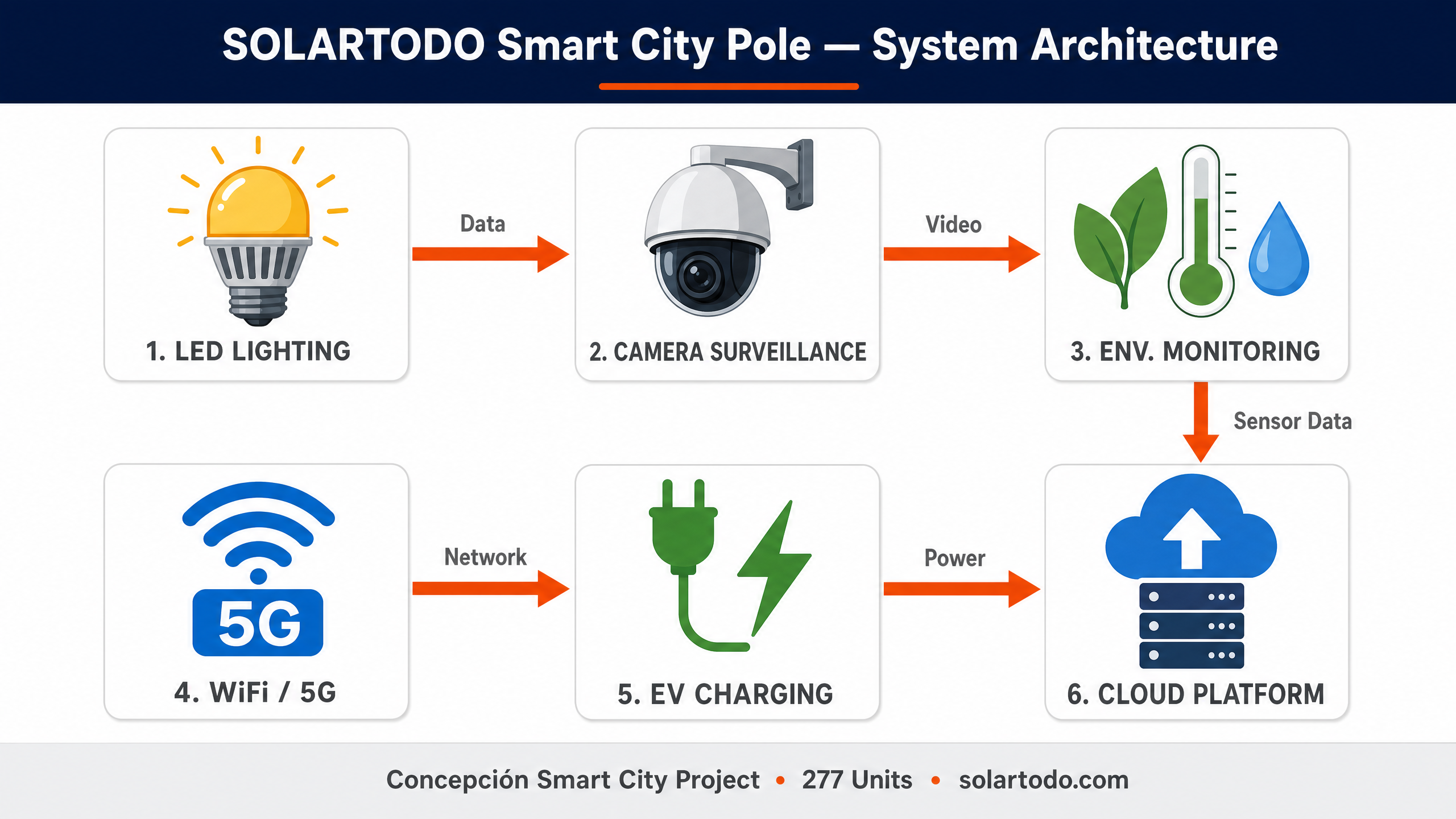
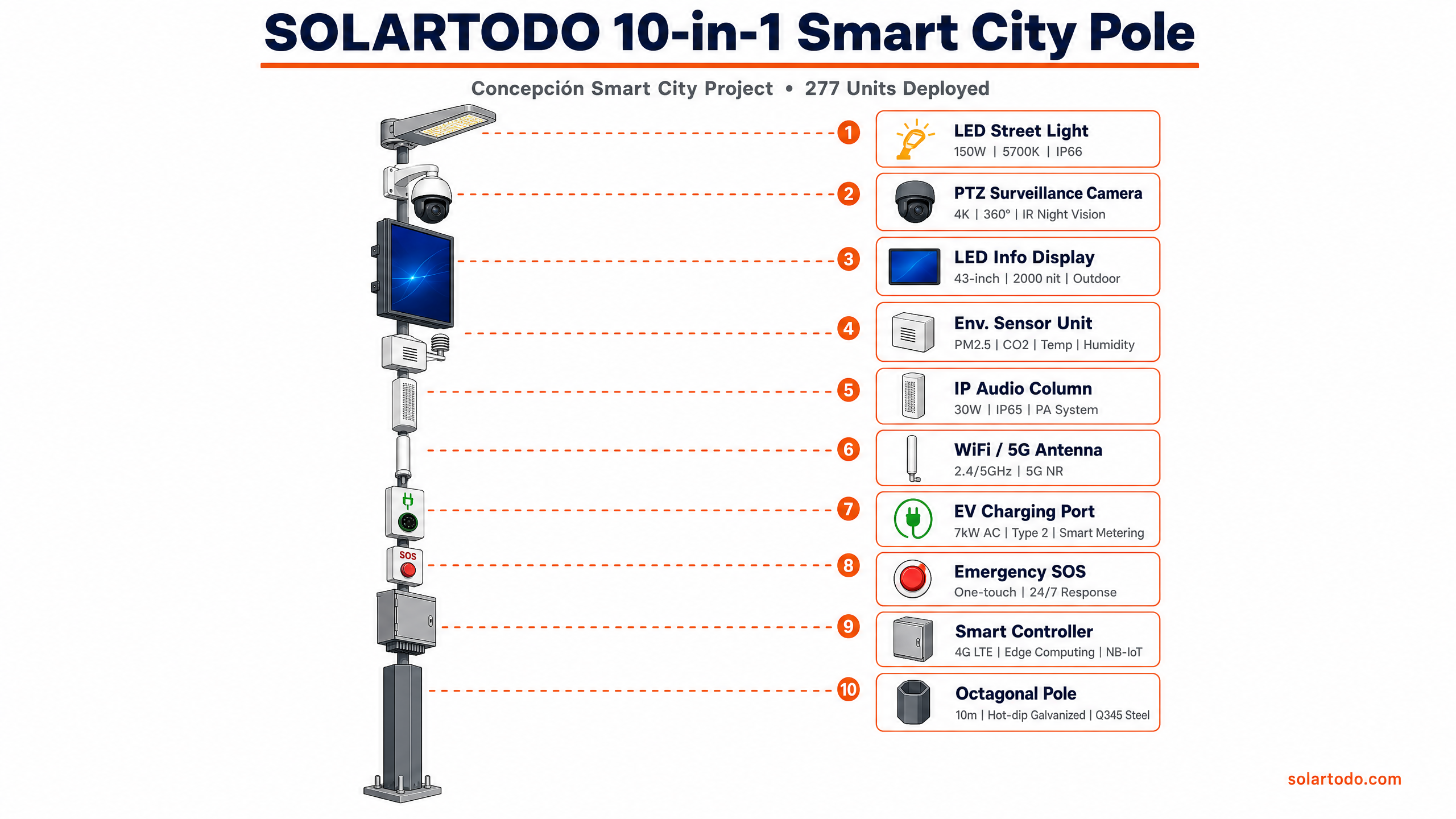
A typical 277-unit deployment in this profile would consist of one LED luminaire and two core smart modules per pole. The lighting package is 150W, 22,500 lumens, 4000K, and 150 lm/W, giving a neutral-white output suitable for mixed traffic and pedestrian environments. The surveillance package is an HD camera with 400W IR, H.265+ compression, IP67 enclosure rating, and 30W power draw. The environmental package is an 8-in-1 sensor at 5W, tracking wind, temperature, humidity, pressure, noise, PM10, and PM2.5.
Optional modules should be selected by corridor function. On transit streets, civic plazas, or emergency-information routes, the pole can add a P4 LED display, 1024×512 mm, 200W for notices and wayfinding. In university districts, evacuation routes, or public-safety corridors, a TCP/IP IP audio column, 30W, 93 dB can support voice alerts. Because the control system is specified as gateway + local dashboard, the recommended architecture is a zone-based network with manageable node counts rather than a fully centralized cloud-only topology.
For Concepción, the strongest use cases are:
- central business district and civic corridors with 30m spacing needs
- university and hospital approaches requiring camera coverage at 10m mounting height
- logistics and port-connector avenues where 150W / 22,500 lm supports wider carriageways
- residential-arterial transitions where PM and noise monitoring can support environmental enforcement
SOLAR TODO should therefore be positioned in Concepción as a grid-powered Smart Streetlight solution for urban roads that need lighting plus sensing, not as an off-grid solar streetlight or a decorative smart plaza pole. Buyers comparing options can review the product category at /products/smart-streetlight or discuss corridor-specific layouts through /contact.
Technical Specifications
The specified Concepción configuration is a 10m standard Smart Streetlight with 277 poles, 150W LED, and 30m spacing, built to IEC 60598 and GB/T 37024 for municipal urban-road applications.
- Pole type: 10m octagonal hot-dip galvanized steel pole
- Application class: urban street / collector road / arterial road
- Pole finish: hot-dip galvanized for coastal humidity and corrosion exposure
- Quantity basis: approximately 277 units for a corridor package of this scale
- Luminaire power: 150W LED
- Luminous flux: 22,500 lm
- Luminous efficacy: 150 lm/W
- CCT: 4000K
- Road width basis: 16m
- Pole spacing: 30m
- Density equivalent: about 33 poles per km
- Operating schedule: 10 hours/day
- Legacy fixture replaced: 250W HPS
- Expected lighting energy reduction: about 40% versus 250W HPS
- Camera module: HD camera, 400W IR, H.265+, IP67, 30W
- Environmental sensor: 8-in-1, 5W, measuring wind, temperature, humidity, pressure, noise, PM10, PM2.5
- Optional display: P4 LED display, 1024×512 mm, 200W
- Optional audio: IP audio column, 30W, 93 dB, TCP/IP networked
- Control system: networked gateway + local dashboard
- Power source: grid-powered AC
- Standards cited: IEC 60598, GB/T 37024
From an electrical loading perspective, the base pole consumes about 185W when combining 150W LED + 30W camera + 5W sensor. If the optional display and audio column are both added, the connected load rises to about 415W per pole, excluding communication overhead. That number matters for feeder sizing, breaker grouping, and cabinet planning on municipal circuits.
According to IEC (2020), luminaires under IEC 60598 must meet safety requirements covering insulation, mechanical strength, ingress protection, and thermal performance. According to IEA (2022), LED systems can reduce electricity use by 50% or more compared with legacy technologies in many applications, so the specified 40% saving versus 250W HPS is conservative for procurement modeling.
Implementation Approach
A practical Concepción rollout would proceed in 4 phases over roughly 4-8 months, starting with corridor survey and utility checks, then foundations and pole erection, followed by network commissioning and municipal acceptance testing.
Phase 1 is corridor definition and electrical survey. For a 277-unit program, the municipality or EPC contractor would typically divide streets into 4-8 zones based on feeder availability, traffic management constraints, and communications backhaul. Pole positions should be checked against underground utilities, curb lines, intersections, and camera sightlines. On a 16m road width, spacing of 30m should be validated against local illuminance targets and obstruction points such as trees or overhead signs.
Phase 2 is procurement, fabrication, and FAT. The 10m octagonal galvanized poles, 150W LED luminaires, and smart modules should be inspected against IEC and municipal tender requirements before shipping. For coastal Chile, galvanization thickness, door sealing, cable entry, and fastener corrosion resistance should be reviewed carefully. A gateway-based control architecture also requires confirmation of cabinet layout, local dashboard functions, and integration protocol details before dispatch.
Phase 3 is civil and mechanical installation. Typical works include anchor bolt setting, foundation curing, conduit preparation, pole erection, luminaire mounting, and module installation. Because the camera is IP67 and mounted at 10m, alignment and IR coverage should be tested at night before final handover. Traffic control plans are usually required during erection on active urban roads, especially if the route includes bus corridors or high pedestrian flows.
Phase 4 is electrical energization, software setup, and acceptance. Each zone should be tested for switching logic, camera stream quality, sensor calibration, and dashboard alarm functions. A 10-hour daily lighting schedule can be set initially, then adjusted seasonally. For municipal operators, local training should cover device health checks, spare-part handling, and cleaning intervals for optics and sensor inlets.
Expected Performance & ROI
For a 277-pole Concepción layout, the specified base load of about 185W per pole would consume roughly 187 kWh/day, while replacing 250W HPS can reduce lighting energy use by about 40% before adding operational benefits from remote monitoring.
Using the stated schedule of 10 hours/day, the LED lighting load alone equals 150W × 277 × 10h = 415.5 kWh/day. A 250W HPS baseline at the same quantity and schedule equals 692.5 kWh/day, so lighting-only savings are about 277 kWh/day, or roughly 101,105 kWh/year. This aligns with the stated 40% energy reduction. If the base smart modules are included, the total connected energy use increases, but the municipality gains surveillance and environmental data without deploying separate poles and cabinets.
Maintenance economics also improve. According to the U.S. Department of Energy (2023), LED street lighting generally lowers maintenance frequency because rated lifetimes are much longer than legacy discharge lamps. According to NREL (2021), networked lighting controls can further improve operational efficiency through fault visibility and scheduling. In Concepción, that means fewer night patrols to identify failed lamps and faster response to device faults using the local dashboard.
ROI should be modeled in two layers. The first layer is direct electricity and maintenance savings from replacing 250W HPS with 150W LED. The second layer is avoided infrastructure duplication, because one smart pole can host lighting, camera, and environmental sensing in a single structure. For corridors that would otherwise require a separate CCTV pole every 80-120m and stand-alone air-quality hardware, the shared-pole approach can reduce civil works, permitting complexity, and street clutter.
Expected non-energy outcomes include:
- improved incident visibility from HD H.265+ video at 10m mounting height
- corridor-level PM10 and PM2.5 trend data from 8-in-1 sensors
- lower outage detection time through gateway + local dashboard alerts
- better public communication where 200W P4 displays or 93 dB IP audio are justified
A reasonable municipal payback discussion usually lands in the medium-term range, but the exact period depends on Chilean electricity tariffs, trenching conditions, communications scope, and how many optional modules are selected. SOLAR TODO can support a bill-of-materials review and staged quotation through /contact.
Results and Impact
For Concepción, the main impact of a 277-unit Smart Streetlight program would be a combined lighting, monitoring, and environmental data layer across about 8.3 km of urban road at 30m spacing.
That scale is meaningful for district-level planning. At roughly 33 poles per km, a municipality could cover a central corridor, a university connector, or a logistics approach with consistent lighting and data capture. The environmental sensor set provides basic urban observability without deploying separate mast infrastructure. The camera package adds public-safety and traffic-review value while preserving a single-pole streetscape.
This is also a practical modernization path for Chilean cities replacing sodium lighting stock. According to IRENA (2022), digitalization and efficiency upgrades in public infrastructure improve both operating performance and system visibility. For Concepción, the likely result is not just lower kWh consumption, but a more manageable municipal asset base with fewer standalone devices to maintain.
Comparison Table
The table below compares the recommended Concepción Smart Streetlight configuration against a conventional 250W HPS streetlight and a basic LED-only pole without smart modules.
| Metric | Recommended SOLAR TODO Smart Streetlight | Conventional 250W HPS Pole | Basic LED-Only Pole |
|---|---|---|---|
| Pole height | 10m | 9-10m typical | 9-10m typical |
| Pole material | Octagonal hot-dip galvanized steel | Steel, varies | Steel, varies |
| Luminaire power | 150W LED | 250W HPS | 150W LED |
| Light output | 22,500 lm | Lower effective maintained output | 22,500 lm |
| Efficacy | 150 lm/W | Lower than LED benchmark | 150 lm/W |
| CCT | 4000K | Amber/yellow typical | 4000K |
| Spacing basis | 30m | 25-35m typical | 30m |
| Road width basis | 16m | 16m typical | 16m |
| Camera | HD, H.265+, IP67, 30W | No | No |
| Environmental sensing | 8-in-1, 5W | No | No |
| Optional display | P4, 1024×512 mm, 200W | No | No |
| Optional audio | TCP/IP, 30W, 93 dB | No | No |
| Control | Gateway + local dashboard | Usually photocell/timer | Basic timer or CMS |
| Daily lighting energy per 277 poles | 415.5 kWh | 692.5 kWh | 415.5 kWh |
| Relative lighting energy saving | ~40% vs HPS | Baseline | ~40% vs HPS |
| Separate poles needed for CCTV/sensors | Usually no | Yes | Usually yes |
Pricing & Quotation
SOLAR TODO offers three pricing tiers for this product line: FOB Supply (equipment ex-works China), CIF Delivered (including ocean freight and insurance), and EPC Turnkey (fully installed, commissioned, with 1-year warranty). Volume discounts are available for large-scale deployments. Configure your system online for an instant estimate, or request a custom quotation from our engineering team at [email protected].
Frequently Asked Questions
This FAQ answers the main procurement questions for a 277-unit, 10m, 150W Concepción Smart Streetlight configuration, including specifications, installation, maintenance, warranty, and commercial scope.
Q1: What Smart Streetlight configuration is most suitable for Concepción’s urban roads?
For the stated road profile, the best fit is a 10m octagonal hot-dip galvanized steel pole with 150W LED, 22,500 lm, 4000K, and 30m spacing on 16m-wide roads. This is an urban street class solution, not a park light or highway mast. It also supports camera and environmental sensing on the same structure.
Q2: Why is grid-powered AC recommended instead of hybrid solar for this project?
Concepción’s dense urban corridors already have utility access, and the project brief specifies grid-powered AC with 10-hour daily operation. In this setting, grid supply simplifies feeder design, keeps pole form factors conventional, and supports stable operation of 150W lighting, 30W cameras, and optional 200W displays without large batteries.
Q3: How many poles would a typical deployment of this scale require?
A typical deployment at the stated scope would require approximately 277 units. With 30m spacing, that equals about 8.3 km of road coverage and around 33 poles per km. Actual quantity can vary slightly after site survey, especially near intersections, bus stops, medians, and utility conflict points.
Q4: What energy savings can be expected compared with 250W HPS streetlights?
The brief states about 40% energy saving when replacing 250W HPS with 150W LED. For 277 poles at 10 hours/day, lighting energy drops from about 692.5 kWh/day to 415.5 kWh/day, saving roughly 277 kWh/day before considering any maintenance savings or smart-control benefits.
Q5: What is included in the core smart module package?
The core package includes one HD camera with 400W IR, H.265+, IP67, and 30W power draw, plus one 8-in-1 environmental sensor at 5W. The sensor tracks wind, temperature, humidity, pressure, noise, PM10, and PM2.5. This gives municipalities both security visibility and basic environmental monitoring from one pole.
Q6: What optional modules are available for Concepción corridors?
Two specified options are a P4 LED display sized 1024×512 mm at 200W, and a TCP/IP IP audio column at 30W and 93 dB. These options are useful for emergency messaging, wayfinding, or civic announcements, but they should be limited to corridors with clear operational need to control total connected load.
Q7: How long would installation typically take for a 277-pole project?
A project of this scale typically takes about 4-8 months, depending on permitting, civil works, shipping lead time, and traffic-control windows. The usual sequence is survey, foundation works, pole erection, electrical connection, network setup, and acceptance testing. Rainfall season and utility coordination can extend the schedule in Concepción.
Q8: What maintenance plan is appropriate for this Smart Streetlight system?
A practical plan includes quarterly visual inspection, semiannual cleaning of optics and sensor inlets, and annual checks of door seals, grounding, and communication status. Cameras and sensors should be reviewed through the local dashboard for alarms and offline events. Coastal humidity makes corrosion inspection important, especially at doors, fasteners, and cable entries.
Q9: How does this compare with installing separate light poles, CCTV poles, and sensor masts?
A combined Smart Streetlight reduces street clutter and can lower civil works because lighting, video, and sensing share one 10m structure. Separate systems may require additional foundations, cabinets, and permits every 80-120m for CCTV or environmental nodes. The single-pole approach is usually more manageable for municipal maintenance teams.
Q10: What warranty and quotation structure should buyers expect?
The quotation can be structured as FOB Supply, CIF Delivered, or EPC Turnkey, depending on scope. The required pricing section states that EPC Turnkey includes installation, commissioning, and a 1-year warranty. Buyers should confirm exact warranty terms by component, especially for luminaires, cameras, displays, and control hardware.
References
- International Energy Agency (2022): LED lighting remains the most energy-efficient mainstream lighting technology and is central to electricity-saving strategies in public infrastructure.
- International Electrotechnical Commission (2020): IEC 60598 sets general requirements and tests for luminaires used in street and area lighting applications.
- National Renewable Energy Laboratory (2021): Networked lighting controls improve visibility of faults, scheduling, and operational management in connected lighting systems.
- U.S. Department of Energy (2023): LED street lighting reduces maintenance frequency and electricity use compared with legacy discharge lighting technologies.
- Instituto Nacional de Estadísticas, Chile (2017 Census / official municipal demographic reporting): Concepción commune population exceeds 220,000, while Greater Concepción is one of Chile’s largest metropolitan areas.
- Dirección Meteorológica de Chile (latest climatological normals/public climate data): Concepción has a rainy coastal climate with annual precipitation above 1,000 mm, relevant for corrosion protection and enclosure selection.
- Superintendencia de Electricidad y Combustibles, Chile (current regulatory framework): Public lighting and low-voltage electrical installations in Chile must comply with certified equipment and electrical safety requirements.
Equipment Deployed
- 277 × 10m octagonal hot-dip galvanized steel Smart Streetlight poles
- LED luminaire: 150W, 22,500 lm, 150 lm/W, 4000K
- Pole spacing design: 30m for 16m road width
- HD camera module: 400W IR, H.265+, IP67, 30W
- 8-in-1 environmental sensor: wind, temperature, humidity, pressure, noise, PM10, PM2.5, 5W
- Optional LED display: P4, 1024×512 mm, 200W
- Optional IP audio column: TCP/IP networked, 30W, 93 dB
- Network control system: gateway + local dashboard
- Grid-powered AC electrical architecture
- Compliance basis: IEC 60598 and GB/T 37024