Georgetown, Guyana Power Transmission Tower Market Analysis: 220kV Double-Circuit Configuration Guide
Summary
Georgetown’s coastal load growth and Guyana’s transmission expansion plans support a 220kV backbone configuration using approximately 44 steel tubular poles over about 7km. A technically matched layout uses 35m double-circuit monopoles, ACSR 400 conductor, 35m/s wind design, and anchor-bolt cage foundations.
Key Takeaways
- Georgetown’s recommended backbone class in this analysis is 220kV double circuit, which aligns with the project-specific configuration of 35m steel tubular poles at about 35t per pole.
- A typical line of this scale would use approximately 44 units across about 7km, with a stated 150m span and ACSR 400 conductor rated at 1520kg/km and 110kN max tension.
- The specified pole form is a tapered steel tubular pole, not lattice, with hot-dip galvanized Q345 steel, flanged bolt sections, and a 30-year design life.
- For Georgetown’s coastal weather profile, the selected environmental basis is Wind Class 3 at 35m/s, with anchor-bolt cage concrete foundations and accessories including bird guards and vibration dampers.
- Electrical geometry in this guide uses 6m phase spacing, 7m ground clearance, and 2.5m insulator length, which places the design in the high-voltage transmission backbone category.
- According to the World Bank (2024), Guyana’s population is about 830,000, while urban and industrial demand near Georgetown continues to shape higher-capacity transmission requirements.
- According to the International Energy Agency (2023), electricity demand growth in emerging systems increasingly requires stronger transmission links; for Georgetown, that means fewer high-capacity corridors rather than dense low-voltage pole counts.
- SOLAR TODO positions this product line for utility and EPC buyers needing IEC 60826 / GB 50545 / DL/T 5092 compliance and a quotation path through /products/power-tower or /contact.
Market Context for Georgetown
Georgetown is Guyana’s primary urban load center, and its grid planning logic increasingly favors high-capacity transmission backbones that can move bulk power efficiently into coastal demand zones. According to the World Bank (2024), Guyana’s population is approximately 830,000, with a significant share concentrated on the coast where Georgetown anchors public services, port activity, commercial buildings, and growing industrial demand.
The local climate matters for tower selection because Georgetown sits on a low-lying Atlantic coast at roughly 6.8, -58.16, where corrosion risk, saturated soils, and storm exposure affect pole material and foundation choices. According to the World Bank Climate Change Knowledge Portal (2021), Guyana’s coast faces high rainfall and flood exposure, which supports the use of hot-dip galvanized steel, elevated electrical clearances, and concrete foundations with an anchor cage rather than untreated alternatives.
Guyana’s power sector is also changing structurally. According to the Government of Guyana and Guyana Power and Light planning updates published in recent years, the country is expanding generation and transmission infrastructure to support economic growth, including new utility-scale power inputs and stronger interconnection between generation sources and coastal loads. That matters in Georgetown because a 220kV line is not a neighborhood distribution asset; it is a backbone asset used when transfer capacity, grid stability, and future scalability are the priority.
The correct engineering sequence is to choose voltage class first, then derive tower height, weight, and span. For 220kV, the hard constraint range is 35-55m height, 15-35t per pole, and typically 2-3 poles/km with 350-450m spans under generic conditions. This article uses the project-specific configuration exactly as provided: 35m height, about 35t/pole, double circuit, and 150m span over about 7km. The shorter span indicates a conservative layout suited to local right-of-way, urban interface, coastal wind loading, or route constraints rather than a maximum-span rural corridor.
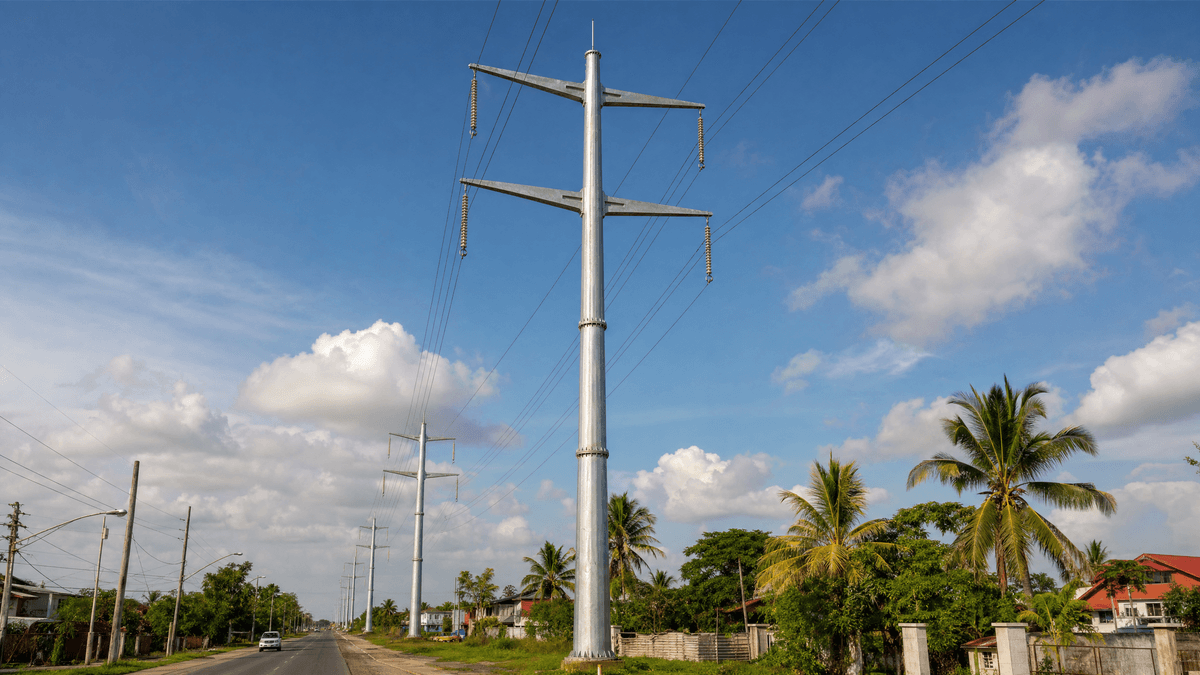
For buyers comparing structures, the relevant product here is a steel tubular monopole-style transmission support, not a lattice tower. SOLAR TODO uses the natural product category Power Transmission Tower for this line, but technically the structure is a tapered steel tubular pole fabricated in flanged bolt sections with cross-arm brackets for insulator strings and ACSR conductors. That distinction is important in Georgetown, where footprint, transport logistics, and urban corridor aesthetics can favor tubular steel over lattice assemblies.
According to IRENA (2023), transmission investment is a critical enabler of renewable and conventional generation integration in developing power systems. According to the IEA (2023), “Grids are the backbone of electricity systems,” and delayed network reinforcement can constrain economic growth even when generation capacity is available. Those statements apply directly to Georgetown’s market context: if generation expands faster than transmission, the coastal load center still faces bottlenecks.
As a result, a Georgetown-specific market analysis points to a high-voltage backbone requirement rather than a 10-35kV distribution pole program. A 35kV line would normally require only 12-18m poles and 1-3t/pole, which is not consistent with the provided 220kV backbone specification. For this reason, the technically matched recommendation remains a 220kV double-circuit steel tubular configuration in the 35m class.
Recommended Technical Configuration
A Georgetown backbone corridor of this profile would typically use approximately 44 hot-dip galvanized 220kV steel tubular poles over about 7km, with 35m height, double-circuit arrangement, and ACSR 400 conductor.
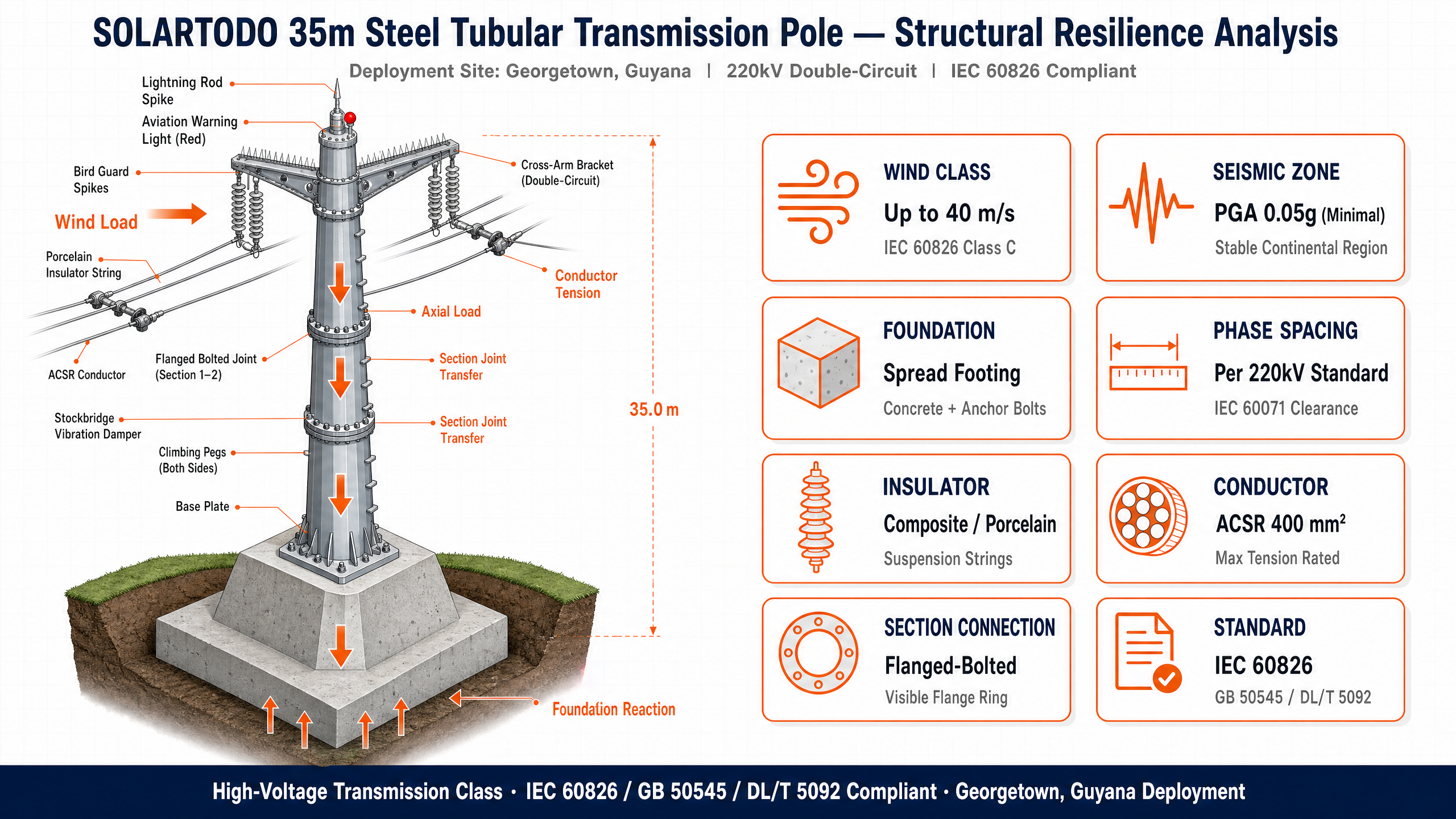
Based on the provided project-specific configuration and Georgetown’s coastal transmission needs, the recommended arrangement is a 220kV double-circuit Power Transmission Tower system using 44 units × 35m tapered steel tubular poles. The structure material is Q345 steel with hot-dip galvanizing, which is a practical choice for saline air exposure and long-term corrosion control near the Atlantic coast.
The conductor recommendation is ACSR 400, with a stated linear weight of 1520kg/km and maximum tension of 110kN. For a 220kV line, this conductor class supports substantial transfer capability while remaining widely understood by utilities and EPC contractors. The line geometry uses 6m phase spacing, 7m ground clearance, and 2.5m insulator length, all of which are appropriate to a high-voltage transmission backbone rather than a medium-voltage feeder.
The route length in this guide is about 7km, and the layout uses a stated 150m span. Multiplying 7,000m / 150m yields roughly 46.7 span intervals, so a practical pole count of approximately 44 units is directionally consistent once dead-end structures, angle points, and terminal arrangements are considered in a real alignment study. The key point is that buyers should treat the quantity as a planning basis, not a claim of completed installation.
For foundations, the specified solution is a concrete anchor-bolt cage foundation. That is a suitable choice where urban access, variable coastal soils, and erection speed matter. A geotechnical campaign would still be required in Georgetown because groundwater level, soft marine clays, and floodplain conditions can change embedment depth, reinforcement density, and pedestal detailing across a 7km route.
Accessories in the recommended package include climbing steps, cross arm, grounding, bird guard, and vibration damper. These are not minor add-ons. In a coastal 220kV corridor, grounding performance and conductor vibration control directly affect outage risk and maintenance intervals. SOLAR TODO should therefore be evaluated not only on pole shaft fabrication, but also on the completeness of the line hardware package and standards documentation.
A buyer comparing options can review the product page at Power Transmission Tower and request route-specific design input through contact us. For Georgetown, the strongest technical fit is not the tallest possible structure; it is the correct 220kV class with the specified 35m height and a conservative span pattern suited to local conditions.
Technical Specifications
This Georgetown configuration is a 220kV double-circuit steel tubular pole system with 35m height, about 35t structural weight, 150m span, and IEC 60826 / GB 50545 / DL/T 5092 compliance.
- Product type: Power Transmission Tower in steel tubular monopole form
- Structure form: Tapered steel tubular pole, flanged bolt sections
- Voltage class: 220kV high-voltage transmission backbone
- Circuit configuration: Double circuit
- Pole quantity basis: Approximately 44 units
- Pole height: 35m
- Pole weight: ~35t/pole
- Unit mass basis: 1000kg/m for double-circuit variant
- Line length: ~7km
- Span: 150m
- Material: Hot-dip galvanized Q345 steel
- Phase spacing: 6m
- Ground clearance: 7m
- Conductor: ACSR 400
- Conductor linear weight: 1520kg/km
- Maximum conductor tension: 110kN
- Insulator length: 2.5m
- Wind class: Class 3, 35m/s
- Foundation type: Concrete anchor-bolt cage foundation
- Accessories: Climbing steps, cross arm, grounding, bird guard, vibration damper
- Design life: 30 years
- Applicable standards: IEC 60826 / GB 50545 / DL/T 5092
From the engineering table, 220kV systems fall in the 35-55m height band and 15-35t/pole weight band, usually in double-circuit form. This configuration sits at the lower end of the 220kV height range at 35m and at the upper end of the weight range at ~35t, which is technically coherent for a tubular steel backbone structure with conservative spacing and coastal design allowances.
According to IEC, loading design for overhead lines must account for wind, conductor tension, and reliability level in a structured way under IEC 60826. According to ENTSO-E and international utility practice, route-specific clearances and geotechnical data often drive final tower spotting more than nominal voltage alone, which helps explain why a 150m span can be selected even when generic 220kV spans are often longer.
Implementation Approach
A typical Georgetown implementation would proceed in 5 phases over roughly 8-14 months, from route survey and soil investigation to foundation curing, pole erection, stringing, and energization.
Phase 1 is feasibility and route definition. For a 7km corridor, the owner or EPC contractor would usually complete topographic survey, utility crossing review, flood-risk screening, and geotechnical boreholes at intervals appropriate to soil variability. In Georgetown’s coastal plain, geotechnical testing is especially important because foundation performance can vary sharply with groundwater depth and soft alluvial layers.
Phase 2 is detailed design and procurement. At this stage, the structural calculations are checked against IEC 60826, GB 50545, and DL/T 5092, and the bill of materials is frozen for 44 poles, ACSR 400 conductor, insulator strings, grounding kits, dampers, and anchor cages. Factory work would include shaft rolling, longitudinal welding, flange machining, trial fit-up, galvanizing, and pre-shipment inspection.
Phase 3 is logistics and civil works. Tubular poles are typically shipped in bolted sections rather than as one-piece 35m shafts, which reduces port and road transport constraints. For Georgetown, this matters because port handling, urban road geometry, and wet-season scheduling can affect delivery windows. Foundation excavation, rebar placement, anchor-cage alignment, and concrete curing would normally take several weeks before steel erection begins.
Phase 4 is mechanical erection and stringing. Crews would erect pole sections by crane, torque flange bolts to specification, install cross arms and insulator sets, and then string ACSR 400 under controlled sag-tension procedures. Because the conductor tension reaches 110kN, line stringing plans must include proper puller-tensioner sizing, grounding, and weather windows.
Phase 5 is testing and commissioning. This usually includes foundation record verification, bolt torque checks, earthing resistance measurement, conductor clearance confirmation, and utility acceptance testing before energization at 220kV. SOLAR TODO buyers should ask for manufacturing data books, galvanizing records, and as-built documentation as part of the final turnover package.
Expected Performance & ROI
A 220kV double-circuit tubular line in Georgetown would primarily deliver grid-capacity, reliability, and land-use benefits, with economic value typically realized through avoided congestion, reduced outage costs, and lower corridor footprint over a 30-year life.
For transmission assets, ROI is not usually measured like a rooftop solar project with a simple payback based only on kWh savings. Instead, utilities evaluate avoided losses, deferred substation overload, reduced curtailment, improved N-1 resilience, and the value of connecting new generation or industrial demand. According to IEA (2023), grid investment has become a central constraint in power-sector expansion globally, meaning transmission upgrades often unlock larger system benefits than their standalone asset cost suggests.
A tubular steel solution can also reduce land and visual footprint compared with conventional lattice structures in constrained corridors. For Georgetown, that matters near road reserves, drainage channels, and mixed urban-peri-urban land use. According to the World Bank (2021), resilient infrastructure in flood-prone areas should prioritize maintainability and climate-aware design; in practice, galvanized tubular poles and anchor-cage foundations can simplify inspection and standardize component replacement over a 30-year design horizon.
Maintenance costs are usually driven by corrosion monitoring, bolt inspection, insulator washing or replacement, grounding checks, and conductor hardware review. In a coastal environment with 35m/s design wind, vibration dampers and bird guards are low-cost items relative to the outage risk they help reduce. A buyer evaluating SOLAR TODO should therefore compare lifecycle maintenance burden, not just supply scope.
Where utilities assign a value to reduced right-of-way width and faster erection, tubular poles can compare favorably with lattice alternatives. According to IRENA (2023), transmission modernization supports both reliability and renewable integration, and the economic case improves when one corridor can carry higher power density. For a Georgetown route of about 7km, the value proposition is strongest where land constraints, aesthetics, and urban interface matter alongside electrical performance.
Results and Impact
For Georgetown, the expected impact of a 220kV tubular corridor is stronger bulk-power transfer over about 7km, with approximately 44 poles supporting a compact double-circuit route and a 30-year service basis.
The main system result would be improved transmission capacity into or around the Georgetown load area without relying on a larger number of medium-voltage structures. Because the design uses double circuit on each 35m pole, the corridor carries more electrical value per structure than a lower-voltage alternative. That matters where right-of-way is limited or where future load growth could otherwise require a second parallel route.
A second impact is resilience. The specified 35m/s wind class, hot-dip galvanized Q345 steel, and anchor-bolt cage foundation indicate a design basis suited to exposed coastal conditions. While final performance always depends on route survey, geotechnical data, and utility protection design, the configuration is aligned with backbone-duty service rather than light distribution use.
A third impact is procurement clarity. Buyers in Guyana can use this configuration as a reference scope when comparing monopole suppliers, EPC contractors, or alternate conductor packages. SOLAR TODO can support this process by aligning pole geometry, galvanizing records, hardware lists, and standards compliance with utility tender requirements rather than offering an underspecified generic tower.
Comparison Table
This comparison shows why a 220kV 35m double-circuit tubular design is the correct class for Georgetown’s backbone use case, while 35kV and 110kV options fit different network functions.
| Parameter | 35kV Distribution Class | 110kV Sub-Transmission Class | Georgetown Recommended Configuration |
|---|---|---|---|
| Typical network role | Feeder/distribution | Sub-transmission | High-voltage backbone |
| Voltage class | 10-35kV | 66-110kV | 220kV |
| Height range | 12-18m | 18-30m | 35m |
| Weight range | 1-3t/pole | 5-15t/pole | ~35t/pole |
| Circuit type | Single or double | Single or double | Double circuit |
| Typical span | 80-150m | 200-300m | 150m specified |
| Typical poles/km | 8-12 | 4-5 | About 6.3 poles/km at 150m spacing |
| Conductor scale | ACSR 70-120 common | ACSR 120-240 common | ACSR 400 |
| Suitable for Georgetown bulk transfer? | Limited | Moderate | Yes |
| Structure form in this guide | Tubular steel possible | Tubular steel possible | Tapered steel tubular pole |
Pricing & Quotation
SOLAR TODO offers three pricing tiers for this product line: FOB Supply (equipment ex-works China), CIF Delivered (including ocean freight and insurance), and EPC Turnkey (fully installed, commissioned, with 1-year warranty). Volume discounts are available for large-scale deployments. Configure your system online for an instant estimate, or request a custom quotation from our engineering team at [email protected].
Frequently Asked Questions
A Georgetown buyer evaluating a 220kV tubular line usually needs answers on voltage class, foundations, delivery scope, maintenance, warranty, and quotation structure before moving to tender or EPC review.
Q1: Why is 220kV recommended for Georgetown instead of 35kV or 110kV?
For a backbone corridor serving a major coastal load center, 220kV provides much higher transfer capability than 35kV and more future capacity than many 110kV links. The specified 35m double-circuit configuration fits the high-voltage backbone role. A 35kV line would normally use only 12-18m poles, so it would not match this requirement.
Q2: What structure type is specified in this guide?
The specified structure is a tapered steel tubular pole with flanged bolt sections, not a lattice tower. It uses hot-dip galvanized Q345 steel, cross-arm brackets, and a concrete anchor-bolt cage foundation. This form can reduce visual and land footprint in constrained corridors while still supporting 220kV double-circuit service.
Q3: How many poles would a 7km Georgetown route typically require?
This guide uses approximately 44 units over about 7km with a stated 150m span. Actual spotting depends on route angles, terminal structures, crossings, and geotechnical constraints. A final quantity should always be confirmed by detailed survey and profile design rather than assumed from route length alone.
Q4: What conductor and insulator package is recommended?
The recommended conductor is ACSR 400, listed here at 1520kg/km with 110kN maximum tension. The associated insulator length is 2.5m, with 6m phase spacing and 7m ground clearance. Together, these values place the design in the high-voltage transmission category rather than medium-voltage distribution.
Q5: How long would procurement and installation usually take?
A typical schedule for a 7km, 44-pole line can fall in the 8-14 month range, depending on geotechnical conditions, utility approvals, shipping windows, and wet-season constraints. Foundation curing, galvanizing lead time, and conductor stringing logistics often determine the critical path more than shaft fabrication alone.
Q6: What maintenance should be expected over 30 years?
Routine maintenance usually includes visual inspection, galvanizing condition checks, bolt torque verification, grounding resistance testing, insulator review, and damper inspection. In Georgetown’s coastal climate, corrosion monitoring is especially important. A planned annual inspection cycle and a more detailed structural review every few years is a practical utility approach.
Q7: How does a tubular pole compare with a lattice tower?
A tubular pole generally uses a smaller footprint and can be preferable where right-of-way is tight or visual impact matters. Lattice towers can still be effective for long rural spans, but this Georgetown guide focuses on a 35m tubular steel solution because it better suits constrained corridors and a double-circuit 220kV backbone format.
Q8: Is there a simple ROI or payback figure for this type of project?
Usually not in the same way as distributed generation. Transmission ROI is often assessed through avoided congestion, improved reliability, deferred reinforcement elsewhere, and support for new load or generation. Utilities may model benefits over 20-30 years rather than using a short simple payback based only on energy savings.
Q9: What standards should buyers request in the quotation package?
At minimum, buyers should request compliance with IEC 60826, GB 50545, and DL/T 5092, plus galvanizing specifications, weld inspection records, material certificates, and foundation interface drawings. If the utility has local requirements, those should be added to the tender so the pole supplier and EPC contractor price the same scope.
Q10: Does SOLAR TODO provide different commercial scopes?
Yes. SOLAR TODO offers FOB Supply, CIF Delivered, and EPC Turnkey quotation formats for the Power Transmission Tower line. Buyers should compare not only steel supply but also conductor hardware, foundation scope, erection, testing, documentation, and warranty terms before selecting the commercial model.
References
- World Bank (2024): World Development Indicators for Guyana population and macro growth context relevant to national electricity demand.
- World Bank Climate Change Knowledge Portal (2021): Guyana climate risk profile, including rainfall, flood exposure, and coastal vulnerability relevant to foundation and corrosion planning.
- International Energy Agency (IEA) (2023): Electricity Grids and Secure Energy Transitions; states that “Grids are the backbone of electricity systems,” supporting transmission reinforcement analysis.
- International Renewable Energy Agency (IRENA) (2023): Transmission and grid investment guidance for renewable integration and power system strengthening in emerging markets.
- IEC (2019): IEC 60826 design criteria for overhead transmission lines, covering loading, reliability, and environmental actions.
- Ministry of Public Works / Government of Guyana (recent planning publications): National infrastructure and transport development context relevant to Georgetown corridor planning and utility access.
- Guyana Power and Light, Inc. (recent corporate and planning publications): Utility network development context for transmission reinforcement and coastal load service areas.
Equipment Deployed
- 44 × 35m tapered steel tubular Power Transmission Tower poles, 220kV double circuit
- Hot-dip galvanized Q345 steel pole sections with flanged bolt connections
- Approx. 35t per pole, based on 1000kg/m double-circuit class
- ACSR 400 conductor, 1520kg/km, max tension 110kN
- 2.5m insulator strings for 220kV service
- Concrete anchor-bolt cage foundations
- Cross-arm assemblies for double-circuit conductor support
- Grounding system and earthing accessories
- Climbing steps for maintenance access
- Bird guards and vibration dampers
- Wind Class 3 design basis at 35m/s
- Compliance package for IEC 60826 / GB 50545 / DL/T 5092