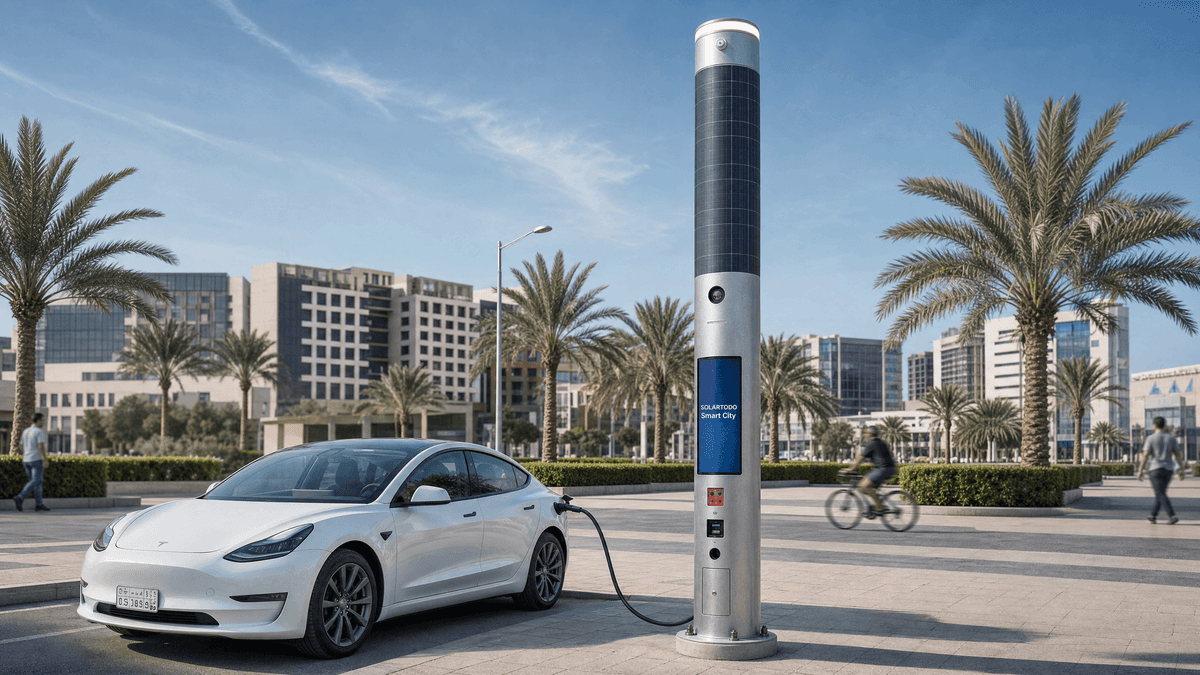
Jeddah Smart Streetlight Market Analysis: 10m Ø219mm Flush-Integrated Configuration Guide
Summary
Jeddah’s hot coastal climate, dense urban corridors, and Vision 2030 public-realm upgrades make a 10m smart streetlight class technically suitable for premium streetscapes. A typical 83-unit layout at 22m spacing would cover about 1.8km, using 100W ring lighting, 7kW AC charging, and 3,000Wh LFP backup.
Key Takeaways
- A typical Jeddah premium boulevard deployment would use approximately 83 units over about 1.8km at 22m spacing.
- The recommended form factor is a 10m seamless Ø219mm cylindrical pole with 5mm wall thickness and constant diameter top-to-bottom.
- Each pole would carry a 100W / 15,000lm / 4000K top 360° LED ring-light band, suitable for urban streets rather than highways.
- Solar assistance is limited to about 200W CIGS thin-film wrapped from 6.5m to 9.3m, paired with 3,000Wh LFP storage and MPPT control.
- Embedded mobility service is a 7kW AC Type 2 charger with a flush flip-cap socket at 1.2m and flush touchscreen at 1.5m.
- Smart-city payload can include 4MP IR 50m camera coverage, 8-parameter environmental sensing, and dual-mode WiFi 6 + 5G communications.
- The specified architecture keeps the pole at Ø219mm all the way down, with no side arms, no widened base, and no external boxes, which matters for Jeddah’s premium waterfront and commercial districts.
- Compliance should be checked against IEC 60598 lighting safety requirements and GB/T 37024 smart-pole functional guidance before municipal approval.
Market Context for Jeddah
Jeddah’s urban form supports premium smart streetlight corridors because the city combines high population density, strong evening activity, and coastal redevelopment demand within a hot marine environment. According to the Saudi Census / General Authority for Statistics (2022), Jeddah Governorate’s population is approximately 4.7 million, making it one of the Kingdom’s largest urban markets and a major candidate for digitally managed street infrastructure.
Climate is a primary design driver. According to the National Center for Meteorology of Saudi Arabia and Climate-Data style long-term records used by planners, Jeddah regularly experiences summer daytime temperatures above 38°C, high salinity from the Red Sea, and seasonal dust. Those factors push buyers toward hot-dip galvanized steel, sealed electronics, and low-protrusion designs that reduce dirt accumulation and corrosion points. For that reason, the monolithic Ø219mm seamless cylindrical smart streetlight profile is a better fit than a modular arm-based pole in prestige districts.
Electric mobility and digital municipal services also support the business case. According to the International Energy Agency (IEA) (2024), global EV sales exceeded 14 million in 2023, and public charging remains a core bottleneck in dense urban corridors. Saudi Arabia’s Vision 2030 urban modernization programs and smart-city initiatives in major cities point toward mixed-use public assets that combine lighting, communications, sensing, and charging in one right-of-way element rather than separate cabinets every 20-30m.
Telecom readiness matters as well. According to the Communications, Space & Technology Commission of Saudi Arabia (CST) and ITU reporting, Saudi Arabia has maintained high mobile broadband penetration and active 5G rollout across major cities. That makes embedded WiFi 6 + 5G backhaul practical for corridor-level services such as public connectivity, municipal telemetry, and fault alarms. In Jeddah, this is relevant for Corniche-adjacent roads, retail streets, and mixed-use redevelopment zones where visual clutter is heavily scrutinized.
Authority guidance also supports multi-service infrastructure. The International Telecommunication Union states, "Smart sustainable cities use information and communication technologies to improve quality of life, efficiency of urban operation and services, and competitiveness." That definition aligns with a smart streetlight that combines 100W lighting, 7kW charging, and environmental sensing in one pole. Similarly, IRENA states, "Cities are at the forefront of the energy transition," which is directly relevant to Jeddah’s urban mobility and public-realm upgrades.
For size class selection, Jeddah’s target streets are urban and commercial corridors, not expressways. The product brief defines a typical density of 25-50m for city streets and excludes highways. Because the project-specific configuration specifies 22m spacing, the recommended use case is a premium urban boulevard or waterfront segment where closer spacing is acceptable to achieve uniformity, digital coverage, and EV access density.
Recommended Technical Configuration
A technically suitable Jeddah configuration is approximately 83 units of 10m seamless Ø219mm cylindrical smart streetlight poles over about 1.8km, using a fully flush-integrated architecture to minimize corrosion points and preserve premium streetscape appearance.
For Jeddah, the correct recommendation is the [V:cyl219] configuration rather than a conventional octagonal pole. The reason is not only aesthetics. Coastal air, pedestrian-heavy frontage, and high-value public-realm districts benefit from a monolithic cylinder with no side arms, no external charger bollards, and no accessory cabinets. A constant Ø219mm diameter from top to bottom reduces attachment interfaces where salt, dust, and water can collect.
A typical 83-unit deployment of this scale would consist of 10m poles fabricated as one monolithic cylinder with 5mm wall thickness and hot-dip galvanized finish in silver-grey. The lighting element would be an embedded top Ø219mm ring-light band, rated 100W, 15,000lm, and 4000K. This output class suits urban collector roads, mixed-use streets, and premium pedestrian-vehicle corridors where lighting uniformity and visual comfort matter more than high-mast throw.
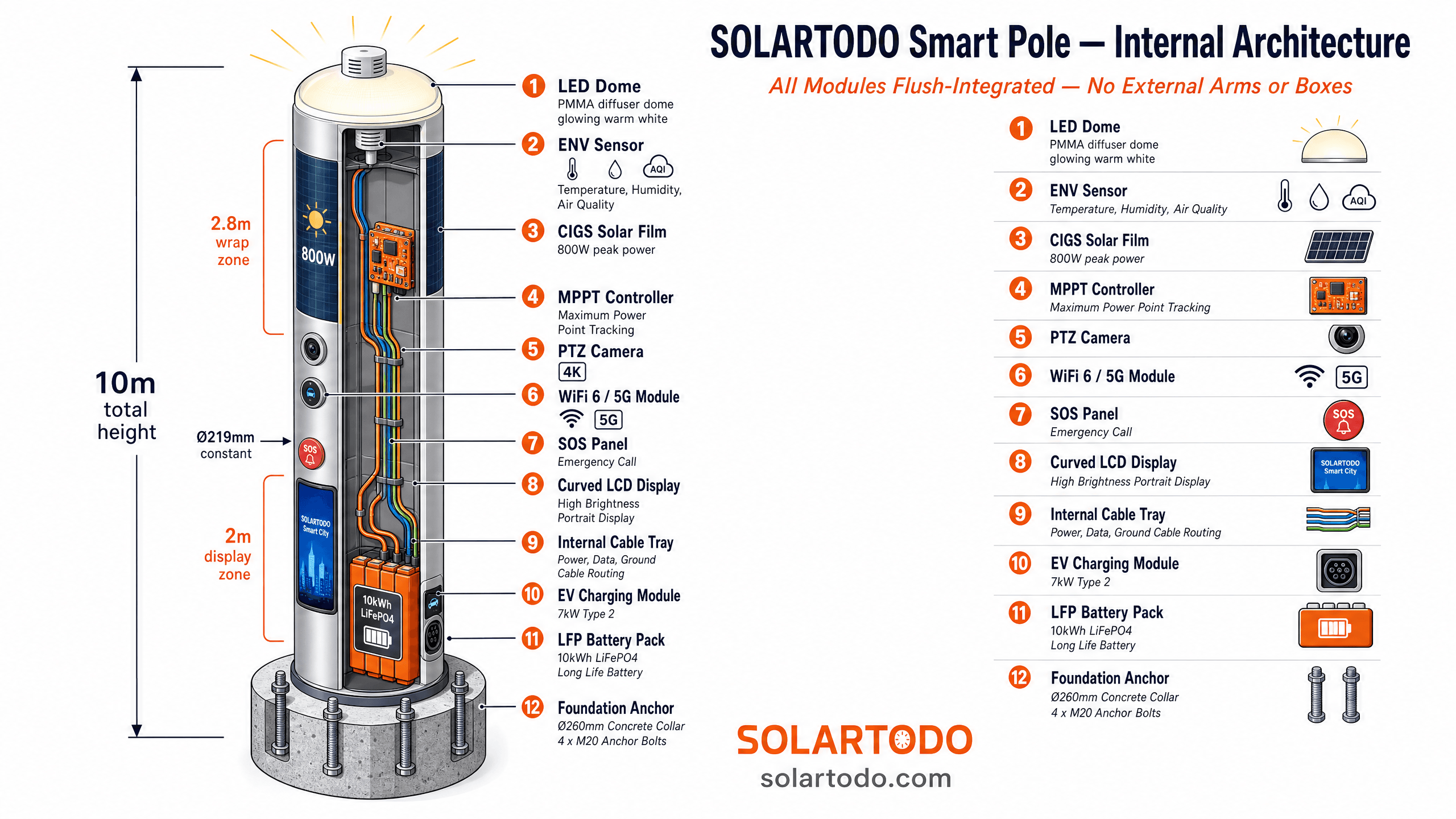
The smart-energy package is intentionally modest. Each pole would use approximately 200W of CIGS flexible thin-film solar cells, wrapped 360° around the mid-section from 6.5m to 9.3m, plus an internal 3,000Wh LFP battery with MPPT. In Jeddah, this should be treated as auxiliary energy support and resilience for smart loads rather than as the sole source for lighting and EV charging. The embedded 7kW AC Type 2 charger remains a grid-connected service, with battery support improving ride-through and control continuity.
The communications and sensing stack matches Jeddah’s smart-city use case. Recommended payload includes an 8-parameter environmental sensor for temperature, humidity, wind, pressure, noise, PM2.5, PM10, and illuminance; a 4MP flush bullet camera with IR 50m; internal WiFi 6 + 5G; and a flush SOS + two-way audio intercom. The display should remain the specified 2200mm × ~170mm curved LCD inset, showing only “SOLARTODO Smart City” in white sans-serif on deep blue, with no advertising content.
For municipal buyers comparing alternatives, this is a premium corridor configuration rather than a mass arterial-road package. If Jeddah seeks lower first cost for secondary roads, a standard octagonal smart streetlight may be sufficient. If the requirement is minimal street clutter, integrated charging, and flush digital modules in a prestige corridor, the SOLAR TODO cylindrical smart streetlight is the stronger technical fit. Buyers can review the product family at /products/smart-streetlight or discuss corridor-specific layouts via /contact.
Technical Specifications
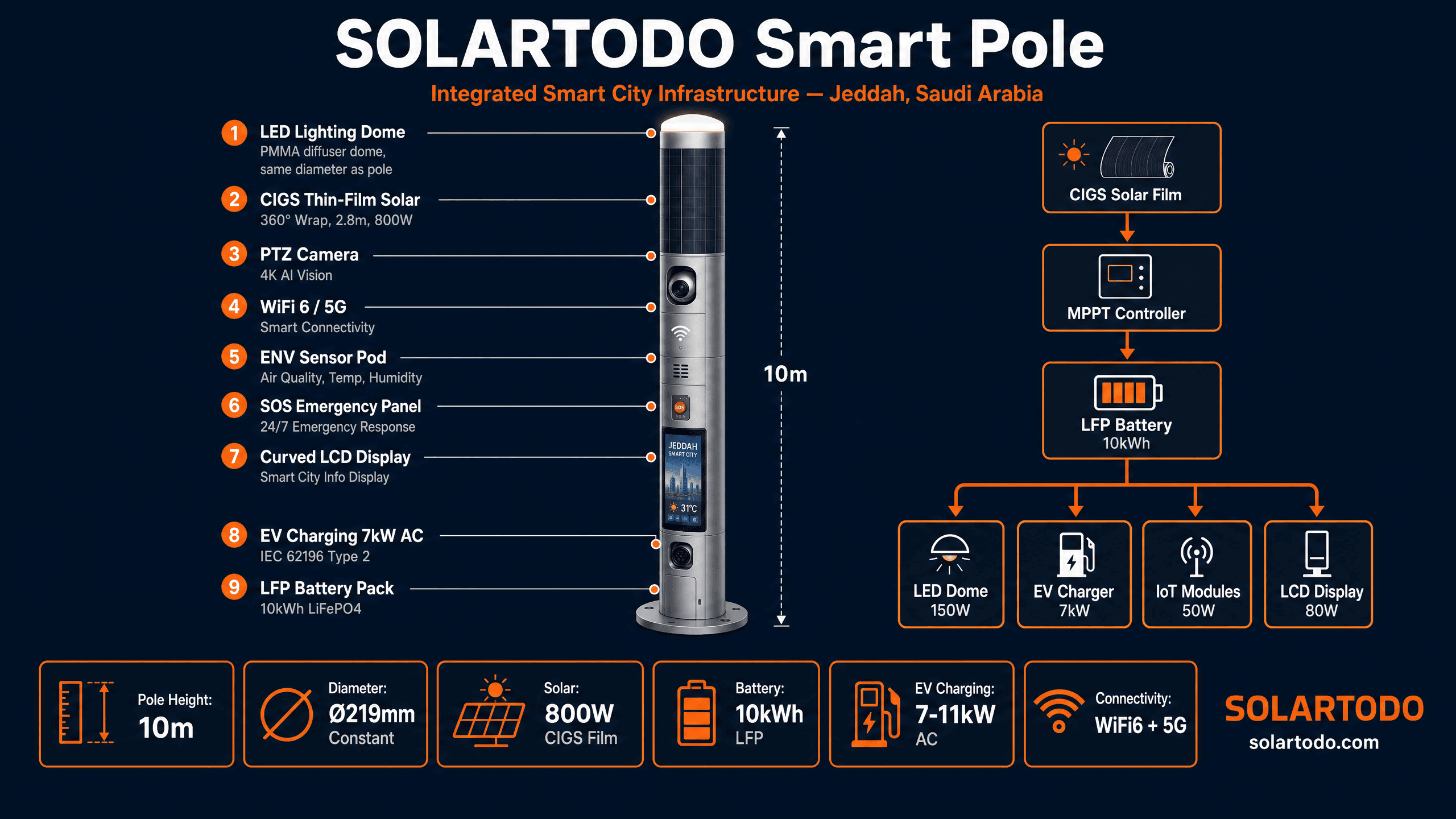
The specified Jeddah corridor configuration uses 83 units of 10m Ø219mm seamless cylindrical poles with 100W ring lighting, 200W CIGS wrap, 3,000Wh LFP storage, and 7kW AC charging, all kept flush within a constant-diameter shell.
- Pole quantity for reference layout: approximately 83 units
- Spacing: 22m center-to-center
- Estimated corridor length covered: about 1,826m or 1.8km
- Pole height: 10m
- Pole form: seamless cylindrical, monolithic, constant diameter top-to-bottom
- Diameter: Ø219mm throughout, including base zone
- Wall thickness: 5mm
- Material / finish: steel, hot-dip galvanized, silver-grey
- Lighting type: top Ø219mm LED ring-light band, embedded, 360° glow
- LED rating: 100W
- Luminous flux: 15,000lm
- CCT: 4000K
- Solar layer: CIGS flexible thin-film, dark blue-black, semi-transparent appearance
- Solar mounting: 360° wrapped flush to pole skin, no brackets, no tilt frames
- Solar active zone: from 6.5m to 9.3m height
- Solar capacity: approximately 200W total per pole
- Battery chemistry: LFP
- Battery capacity: 3,000Wh internal to pole base
- Charge control: MPPT
- Camera: flush bullet type behind rectangular glass window, 4MP, IR 50m
- Environmental sensing: 8 parameters — temperature, humidity, wind, pressure, noise, PM2.5, PM10, illuminance
- Communications: embedded dual-mode WiFi 6 + 5G, internal antennas
- Emergency interface: flush SOS button + two-way audio intercom via pinhole grille only
- EV charging: embedded 7kW AC charger, Type 2 Mennekes
- Charging socket position: flush flip-cap at 1.2m
- Touchscreen position: flush display at 1.5m
- Charging cable: 5m coiled Type 2 cable
- Display: vertical curved LCD, 2200mm tall × ~170mm wide, inset flush into cylinder wall
- Display content restriction: text only — “SOLARTODO Smart City” stacked vertically, white on deep blue
- External design restrictions: no side arms, no outriggers, no external boxes, no widened base, no speaker columns, no public-address modules
- Applicable standards: IEC 60598, GB/T 37024
According to IEC (2020), IEC 60598 sets the safety framework for luminaires, including electrical, thermal, and ingress-related design checks relevant to 100W urban street lighting. According to China’s smart-pole guidance in GB/T 37024, integrated urban poles should coordinate structure, power, communications, and equipment interfaces as one system rather than as loosely attached add-ons.
Implementation Approach
A realistic municipal rollout in Jeddah would take roughly 20-32 weeks from approved drawings to commissioning for an 83-unit corridor, depending on utility permits, civil readiness, and 5G backhaul coordination.
Phase 1 is corridor definition and authority review. This typically covers photometric targets, charger utilization assumptions, and telecom backhaul planning over 2-4 weeks. In Jeddah, the review should also include corrosion class assumptions, salt-fog exposure, and whether the route passes near the waterfront where material protection and enclosure sealing become more critical.
Phase 2 is detailed engineering and procurement, usually 6-10 weeks. This includes foundation drawings, embedded conduit routing, touchscreen and charger interface approvals, and display-content restrictions. Because the pole must remain Ø219mm all the way down with no widened base, the internal equipment stack must be checked carefully for cable bend radius, service access, and thermal management.
Phase 3 is civil works and utility preparation, often 4-8 weeks depending on trenching and feeder readiness. The EV charger is 7kW AC, so feeder sizing, protective devices, earthing, and metering must be aligned with local utility requirements before pole erection. For premium districts, owners often install foundations and conduits first, then keep poles off-site until paving and hardscape are complete.
Phase 4 is pole installation and systems integration, usually 2-4 weeks for this scale. The sequence is foundation cure verification, pole erection, electrical termination, smart controller setup, camera aiming, sensor calibration, charger testing, and cloud onboarding. Since all modules are flush-integrated, installation time per pole can be lower than a multi-cabinet streetscape package, but replacement planning should include access procedures for internal service components.
Phase 5 is commissioning and acceptance. Typical checks include lighting output at 15,000lm, charger communication at 7kW AC, camera image verification at 4MP, and environmental sensor data mapping across the full 83-unit corridor. A practical acceptance package should also include corrosion-protection records, galvanization certificates, and FAT/SAT documentation.
Expected Performance & ROI
For a Jeddah premium corridor, a fully flush 83-unit smart streetlight layout would primarily deliver public-lighting service, digital visibility, and curbside charging access, with ROI driven by avoided clutter, lower civil duplication, and charger utilization rather than by solar generation alone.
According to the U.S. Department of Energy and multiple LED street-lighting studies, LED street lighting commonly reduces energy use by 50-70% versus legacy HID systems, depending on controls and baseline wattage. In this configuration, the 100W LED ring light is already efficient by urban-street standards, so the main savings opportunity comes from replacing separate poles, cabinets, displays, sensors, and emergency call points with one integrated asset. That reduces duplicated foundations, duplicated trench interfaces, and duplicated maintenance visits.
The solar contribution should be treated conservatively. According to NREL (2024), solar resource in western Saudi Arabia is strong, but actual yield depends on temperature, soiling, orientation, and system losses. Because this design uses ~200W of wrapped CIGS on a vertical cylinder rather than optimally tilted panels, it should be viewed as support for smart loads and battery charging, not as a full offset for 7kW EV charging demand. In Jeddah’s dusty coastal environment, vertical wrap may still offer maintenance advantages because it sheds dust differently than low-tilt horizontal surfaces.
On charging economics, utilization matters more than hardware count. A corridor of 83 poles does not necessarily mean all 83 chargers should be energized on day one; a phased energization plan may improve capital efficiency. According to BloombergNEF and IEA charging-market analyses, public AC charging economics improve materially when utilization rises above low single-digit daily sessions. For that reason, many buyers would energize a subset first, then activate additional charger circuits as EV adoption grows.
Operationally, the integrated design can reduce visual clutter and right-of-way occupation. That has value in Jeddah’s commercial and waterfront zones where separate CCTV poles, charger bollards, kiosks, and emergency intercom columns can crowd sidewalks. A typical payback model for this kind of smart streetlight is therefore blended: lighting-energy savings, fewer standalone street assets, lower permit complexity, and possible telecom or municipal digital-service value. Buyers usually model this over 8-12 years, with charger revenue sensitivity tested at multiple utilization rates.
Results and Impact
For Jeddah, the strongest expected impact of this 10m, 83-unit smart streetlight profile is corridor consolidation: one pole can replace several separate street assets while preserving a cleaner urban frontage and supporting 100W lighting, 7kW charging, and real-time sensing.
In practical terms, the design supports four municipal goals at once. First, it improves nighttime lighting quality with a 15,000lm ring source at 4000K. Second, it adds distributed environmental data from 8 sensors per pole. Third, it expands curbside EV access through Type 2 7kW AC charging. Fourth, it creates a digital communications layer through WiFi 6 + 5G without adding visible antenna clutter.
For premium districts, the pole’s most important feature may be what it does not include: no side arms, no external cabinets, no loudspeaker columns, and no widened charger base. In Jeddah, where public-realm quality is under close review, that can be as important as lumen output or charging power. This is where the SOLAR TODO smart streetlight format has a clear technical advantage over conventional add-on smart poles.
Comparison Table
The table below compares the recommended Ø219mm flush-integrated smart streetlight with a conventional modular smart pole for Jeddah urban corridors.
| Metric | Recommended Jeddah Configuration | Conventional Modular Smart Pole |
|---|---|---|
| Pole height | 10m | 8-12m typical |
| Pole profile | Constant Ø219mm cylinder | Octagonal or tubular with add-on arms |
| Wall thickness | 5mm | Varies by vendor |
| Lighting | Embedded top ring, 100W / 15,000lm / 4000K | Side-mounted luminaire, often 80-150W |
| Solar | ~200W CIGS wrap, vertical 6.5m-9.3m | Often none or bracketed rigid panel |
| Battery | 3,000Wh LFP internal | Optional, often external cabinet/base |
| EV charging | 7kW AC Type 2, fully flush | Often separate charger bollard or side box |
| Camera | Flush 4MP, IR 50m | External dome/bullet housing |
| Communications | Embedded WiFi 6 + 5G | External antennas more common |
| Emergency system | Flush SOS + pinhole audio | Separate call box or speaker module |
| Streetscape impact | Very low visual clutter | Medium to high depending on add-ons |
| Jeddah coastal suitability | Strong due to fewer exposed interfaces | Moderate; more joints and protrusions |
Pricing & Quotation
SOLAR TODO offers three pricing tiers for this product line: FOB Supply (equipment ex-works China), CIF Delivered (including ocean freight and insurance), and EPC Turnkey (fully installed, commissioned, with 1-year warranty). Volume discounts are available for large-scale deployments. Configure your system online for an instant estimate, or request a custom quotation from our engineering team at [email protected].
Frequently Asked Questions
This FAQ answers the main buyer questions for a 10m, 83-unit, Ø219mm smart streetlight corridor in Jeddah, including specs, timeline, maintenance, ROI, and quotation structure.
Q1: Why is the Ø219mm cylindrical version recommended for Jeddah instead of a standard octagonal smart pole? The cylindrical version fits premium coastal districts better because it keeps all hardware flush within a constant Ø219mm shell. That reduces exposed brackets, external cabinets, and corrosion-prone joints. In Jeddah’s salt-air and dust conditions, fewer protrusions generally mean easier cleaning and a cleaner visual result along waterfront or retail corridors.
Q2: Is the 200W wrapped CIGS solar layer enough to power the whole pole and the 7kW charger? No. The ~200W CIGS wrap and 3,000Wh LFP battery should be treated as auxiliary support for smart loads and resilience. The 7kW AC Type 2 charger is fundamentally a grid-connected service. In this configuration, solar improves backup capability and partial energy offset, but it does not replace utility supply for charging demand.
Q3: What street type is this 10m smart streetlight suitable for? It is suitable for urban boulevards, waterfront roads, mixed-use districts, and commercial corridors with spacing around 22m. It is not intended for highways, which usually require taller traffic-lighting poles and different photometrics. It is also not a garden or park light, where 6-8m decorative classes are more common.
Q4: How long would an 83-unit deployment typically take in Jeddah? A typical schedule is 20-32 weeks from design approval to commissioning. Engineering and procurement often take 6-10 weeks, civil works 4-8 weeks, and erection plus commissioning another 2-4 weeks. Utility approvals, charger metering, and telecom integration can move the schedule more than pole fabrication itself.
Q5: What maintenance regime should buyers expect? Most owners plan quarterly visual inspections and semiannual functional checks. In Jeddah, cleaning intervals may need to be tighter because of dust and marine deposits, especially on the 2200mm display window, camera glass, and sensor openings. Battery health, charger socket wear, and galvanization condition should be reviewed annually.
Q6: What is the expected ROI or payback period? There is no single payback number because value comes from several streams: LED energy reduction, fewer standalone poles and cabinets, charger revenue, and digital-service benefits. Many municipal or developer models test returns over 8-12 years. If charger utilization is low, payback leans more on infrastructure consolidation than on direct charging revenue.
Q7: How does this compare with installing separate lighting poles, EV chargers, cameras, and kiosks? A separate-asset approach can be simpler for phased procurement, but it usually needs more foundations, more trench interfaces, and more sidewalk space. The integrated 10m Ø219mm option reduces street clutter and can simplify corridor aesthetics. The tradeoff is tighter internal packaging and more careful service-access planning for embedded components.
Q8: What does EPC pricing usually include for this product class? EPC scope normally includes foundations, conduits, pole erection, electrical termination, charger commissioning, network setup, and acceptance testing. It may also include traffic management, civil reinstatement, and cloud onboarding. Buyers should confirm whether utility meter fees, telecom backhaul subscriptions, and municipal software integration are included or treated as separate line items.
Q9: What warranty terms are typical for a smart streetlight like this? Warranty terms vary by contract, but buyers usually split them by subsystem: structural steel, LED driver and luminaire, charger electronics, battery, display, and communications. The quotation section here specifies 1-year warranty for EPC turnkey scope. For procurement, it is good practice to request subsystem warranty matrices and spare-parts lists before award.
Q10: Does the flush design make installation or servicing harder? It can make engineering more exact, but not necessarily harder overall. Because the pole remains Ø219mm with no widened base, internal layout, thermal paths, and service clearances must be checked carefully during design. The benefit is a cleaner streetscape. The tradeoff is that technicians need defined access procedures for charger, battery, display, and communications modules.
References
- General Authority for Statistics, Saudi Arabia (2022): Saudi Census data showing Jeddah Governorate population at approximately 4.7 million.
- International Energy Agency (2024): Global EV Outlook 2024; EV sales exceeded 14 million in 2023 and charging infrastructure remains a core deployment issue.
- International Telecommunication Union (2022): Smart sustainable city framework; defines use of ICT to improve urban services and quality of life.
- International Renewable Energy Agency (2023): Urban energy transition guidance; notes that cities are central to energy-transition implementation.
- IEC (2020): IEC 60598 luminaire safety requirements applicable to street-lighting systems.
- Standardization Administration of China (2019): GB/T 37024 smart pole functional and system guidance for integrated urban-pole design.
- National Renewable Energy Laboratory (2024): Solar resource and PV performance guidance relevant to high-irradiance climates such as western Saudi Arabia.
Equipment Deployed
- 83 × 10m seamless cylindrical smart streetlight poles, Ø219mm constant diameter, 5mm wall, hot-dip galvanized, silver-grey
- Embedded top Ø219mm LED ring-light band, 100W, 15,000lm, 4000K
- CIGS flexible thin-film solar wrap, 360° around 6.5m-9.3m pole section, approximately 200W per pole
- Internal LFP battery pack, 3,000Wh with MPPT charge control
- Flush bullet camera behind glass window, 4MP, IR 50m
- 8-parameter environmental sensor pod: temperature, humidity, wind, pressure, noise, PM2.5, PM10, illuminance
- Embedded dual-mode WiFi 6 + 5G communications with internal antennas
- Flush SOS button with dual-way audio intercom via pinhole speaker grille
- Embedded 7kW AC EV charger with Type 2 Mennekes socket, flush flip-cap at 1.2m
- 5m coiled Type 2 charging cable
- Flush touchscreen interface at 1.5m height
- Vertical curved LCD display, 2200mm × approximately 170mm, showing 'SOLARTODO Smart City' text only