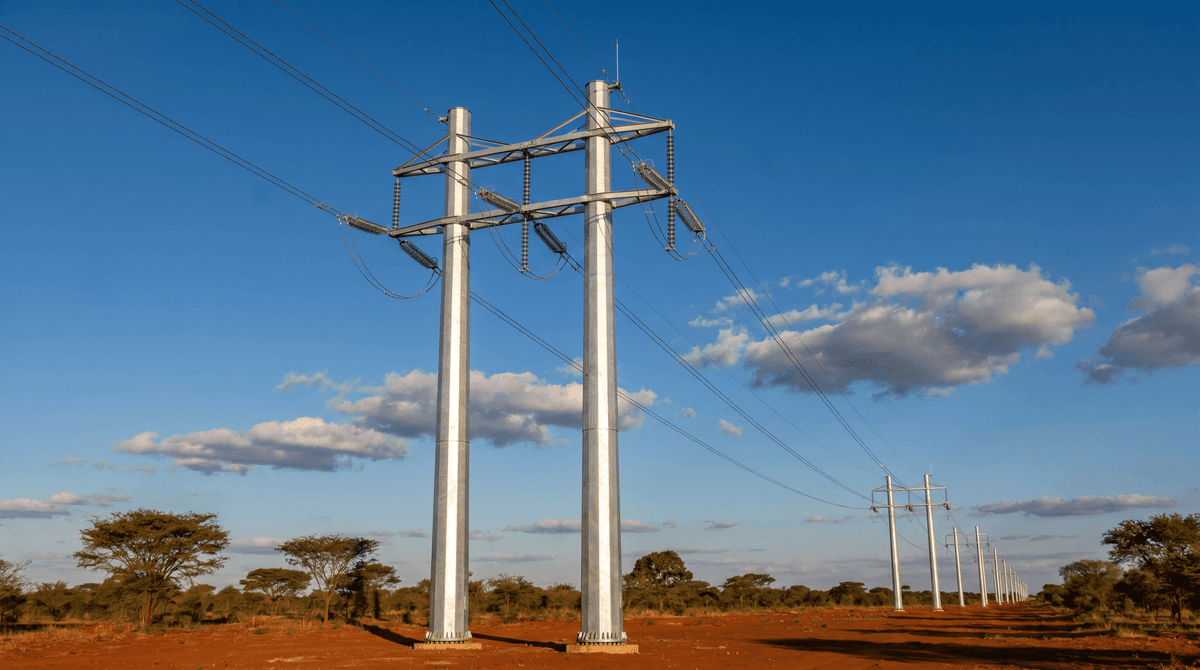
Maputo Power Transmission Tower Market Analysis: 220kV Steel Tubular Pole Configuration Guide
Summary
Maputo’s transmission expansion profile supports a 220kV backbone configuration using approximately 71 steel tubular poles over about 18km, with 40m pole height, 250m spans, and ACSR 240 conductors suited to coastal wind class 25m/s design conditions.
Key Takeaways
- Maputo’s urban load concentration and port-industrial growth support a 220kV transmission backbone class rather than a 10-35kV distribution pole class for bulk power transfer.
- A typical corridor of this scale would use approximately 71 poles across 18km, based on a 250m average span and route geometry allowances.
- The specified pole class is 40m height and about 24t per pole, which fits the 220kV table range of 35-55m and 15-35 t/pole.
- The recommended conductor is ACSR 240 at 920kg/km with maximum tension 70kN, suitable for a single-circuit 220kV line profile.
- Structural design should follow IEC 60826, GB 50545, and DL/T 5092, with Q345 hot-dip galvanized steel and an anchor-bolt cage foundation.
- For Maputo’s coastal exposure, a wind class 1 design at 25m/s plus bird guards, vibration dampers, and grounding is a practical baseline configuration.
- With phase spacing 6m, insulator length 2.5m, and ground clearance 7m, the configuration aligns with high-voltage backbone line requirements for urban-edge routing.
- According to IEA (2023), electricity demand in sub-Saharan Africa continues to rise with urbanization, which increases the value of 30-year design life assets in capital planning.
Market Context for Maputo
Maputo’s grid planning context favors high-voltage backbone reinforcement because the metropolitan area combines dense urban demand, port logistics, and industrial load centers within a coastal corridor.
Maputo is Mozambique’s capital and largest city, located at approximately -25.97, 32.57 on the Indian Ocean coast. According to the World Bank (2024), Mozambique remains in an electricity expansion phase where transmission investment is critical to connect generation, substations, and urban demand centers. According to UN-Habitat (2020), Greater Maputo is one of the country’s main urban growth zones, which raises pressure on bulk power transfer infrastructure rather than only local distribution feeders.
The city’s climate also matters for tower selection. According to the World Bank Climate Change Knowledge Portal (2021), southern Mozambique faces coastal wind exposure, seasonal heavy rainfall, and periodic storm events. For steel support structures, that pushes buyers toward corrosion-protected monopole or tubular solutions with controlled fabrication quality, hot-dip galvanizing, and foundation detailing that can handle variable soil moisture and drainage conditions.
Mozambique’s transmission system is centered on high-voltage interconnection and substation reinforcement, especially around major load corridors. According to Electricidade de Moçambique, EDM (2023), the national grid includes 110kV, 220kV, and higher-voltage transmission assets connecting generation and demand centers. That matters in Maputo because a city-scale backbone route serving substations or industrial demand aggregation is more likely to require a 220kV class structure than a 10-35kV pole line.
Authority guidance also supports a structured design approach. IEC states, "The loading and strength requirements for overhead lines shall be established from climatic, mechanical and electrical conditions" under IEC 60826. IEEE similarly notes in overhead line guidance that wind, conductor tension, and clearances must be treated as integrated design variables rather than isolated component choices. For Maputo, that means voltage class must be selected first, then pole height, weight, span, and insulator geometry should follow.
From a procurement standpoint, steel tubular poles also fit constrained urban and peri-urban rights-of-way better than broad-footprint lattice structures in some corridors. A tubular shaft with flanged sections reduces the ground footprint and can simplify transport segmentation. For buyers evaluating SOLAR TODO Power Transmission Tower solutions, the relevant question is not whether a tower can carry 220kV in theory, but whether the configuration matches Maputo’s corridor constraints, utility standards, and lifecycle maintenance conditions.
Recommended Technical Configuration
For Maputo’s bulk-transfer corridor profile, a 220kV single-circuit steel tubular pole line with approximately 71 units over 18km is the recommended technical fit.
Based on the provided project-specific configuration and the 220kV engineering table, the correct class is a 220kV high-voltage transmission backbone. The table requires 35-55m height, 15-35 t/pole, usually double circuit, and 350-450m typical spans for generic 220kV lines. However, the supplied configuration is a valid project-specific recommendation at 40m height and about 24t per pole, both fully inside the 220kV range. The route span is specified at 250m, which is shorter than the table’s typical range and therefore conservative rather than under-designed.
A typical deployment of this scale in Maputo would consist of approximately 71 tapered steel tubular poles, each fabricated from hot-dip galvanized Q345 steel, arranged as a 220kV single-circuit line over roughly 18km. The line would use ACSR 240 conductor, with a unit mass of 920kg/km and 70kN maximum tension, plus 2.5m insulator strings, 6m phase spacing, and 7m minimum ground clearance. This is a backbone transmission profile, not a medium-voltage distribution line.
The single-circuit selection makes sense where the objective is targeted substation interconnection, corridor reinforcement, or staged expansion without the full steel mass of a double-circuit 220kV arrangement. The product data gives a structural mass of 600kg/m for the single-circuit tubular pole variant, which aligns with the calculated ~24t per 40m pole. For a city-edge route with turning angles, terminal structures, and access constraints, a tubular monopole format can reduce visual width and simplify section-by-section erection compared with lattice alternatives.
For Maputo’s environment, SOLAR TODO would typically recommend adding the supplied accessory set: cross arm, climbing steps, grounding set, bird guard, and vibration damper. Bird activity and conductor motion are practical issues in coastal and estuarine zones. According to IEC (2019), environmental loading and service conditions should be reflected in both structural and accessory design, not only in shaft thickness.
Technical Specifications
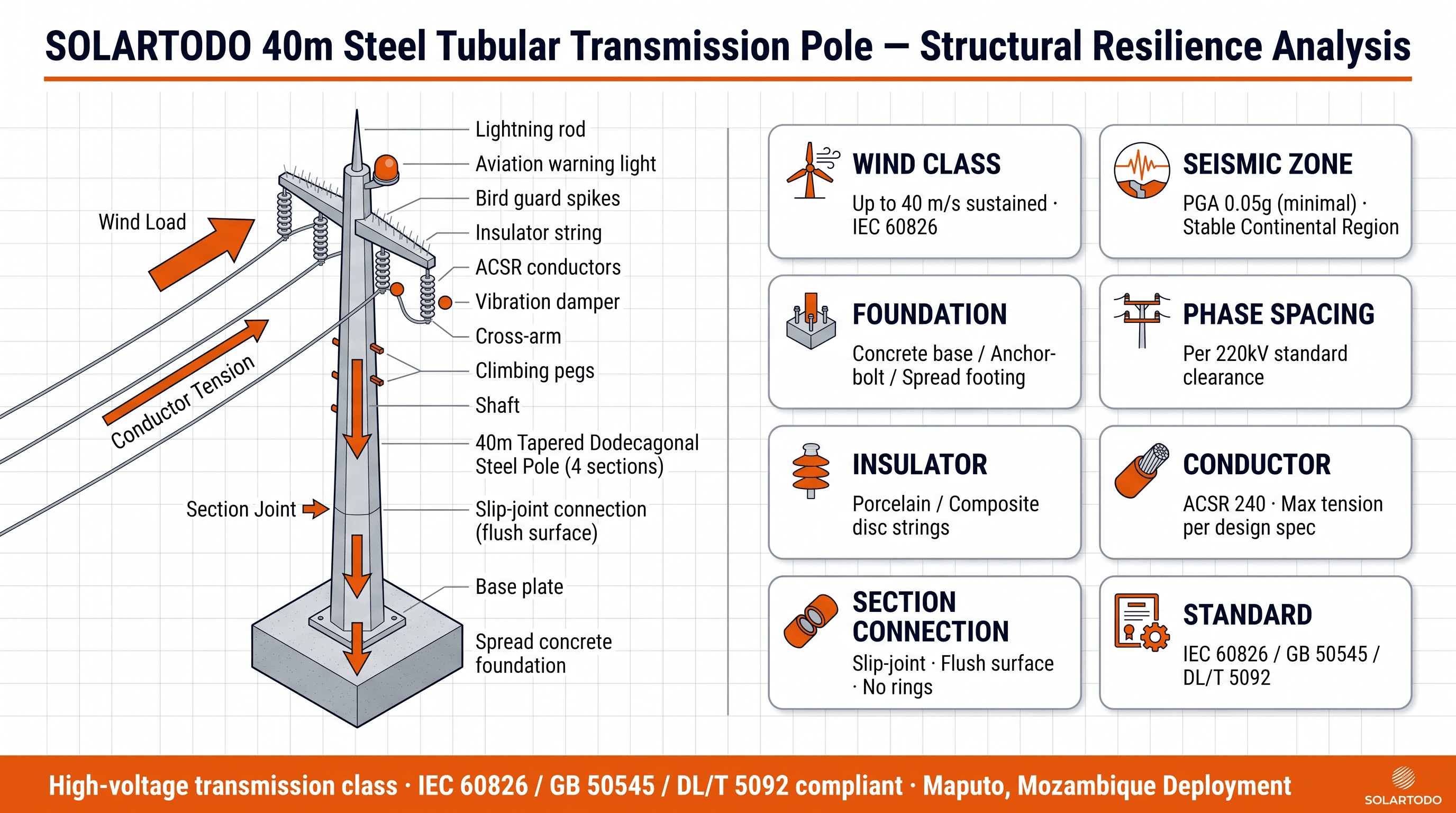
The specified Maputo configuration is a 220kV single-circuit, 40m, approximately 24t steel tubular pole system using Q345 galvanized steel, ACSR 240 conductor, 250m spans, and anchor-bolt cage foundations.
- Product type: Steel tubular Power Transmission Tower in tapered monopole form, not lattice, not FRP, not concrete
- Voltage class: 220kV high-voltage transmission
- Circuit arrangement: Single circuit
- Pole quantity: Approximately 71 units for an ~18km route
- Pole height: 40m
- Pole weight: ~24t/pole
- Linear steel index: 600kg/m
- Material grade: Q345 steel
- Surface protection: Hot-dip galvanizing
- Conductor type: ACSR 240
- Conductor mass: 920kg/km
- Maximum conductor tension: 70kN
- Phase spacing: 6m
- Insulator length: 2.5m
- Ground clearance: 7m
- Average span: 250m
- Wind class: Class 1, 25m/s
- Foundation type: Concrete foundation with anchor-bolt cage
- Accessories: Climbing steps, cross arm, grounding, bird guard, vibration damper
- Design life: 30 years
- Applicable standards: IEC 60826 / GB 50545 / DL/T 5092
The above specification should be read as a high-voltage backbone line package. It is not interchangeable with 10-35kV poles at 12-18m or 66-110kV poles at 18-30m. According to IEC 60826, overhead line design must consider climatic loads, conductor behavior, and reliability level together. That is why a 220kV route in Maputo should stay in the 35-55m structural height band, with corresponding steel mass and insulation geometry.
Implementation Approach
A typical Maputo 220kV rollout would move through survey, foundation works, sectional pole erection, stringing, testing, and utility energization over a staged 6-12 month program depending on permitting and corridor access.
The first phase is route verification and geotechnical investigation. For an 18km line with approximately 71 structures, buyers should expect topographic survey, soil testing at each foundation location, and confirmation of crossing points, turning angles, and substation interfaces. In coastal ground conditions, foundation depth and rebar detailing can change materially between sandy and mixed soils, even when the superstructure remains at 40m.
The second phase is detailed design and fabrication. Tubular poles are commonly produced in flanged sections to reduce shipping length and crane constraints. For a 24t pole, sectionalization supports container or breakbulk planning while keeping galvanizing quality consistent. SOLAR TODO typically positions this stage around standards compliance review, shop drawings, bolt schedules, and conductor-hardware matching before shipment.
The third phase is civil works. Each pole uses a concrete anchor-bolt cage foundation, which should be cast only after bolt template verification and verticality checks. In a 25m/s wind class design, anchor alignment and concrete curing discipline matter because erection tolerances affect shaft fit-up and long-term stress distribution. Foundation works usually determine the critical path more often than steel fabrication.
The fourth phase is erection and stringing. A 40m tubular pole is normally assembled section by section, then bolted and torqued to specification. After that, crews install cross arms, insulator strings of 2.5m, grounding components, bird guards, and vibration dampers, followed by ACSR 240 conductor stringing at controlled tension up to the 70kN design limit. Final checks include grounding resistance, phase clearance, sag-tension verification, and as-built documentation.
The fifth phase is commissioning. Utilities generally require mechanical completion records, galvanizing inspection records, bolt torque logs, conductor stringing charts, and line patrol acceptance before energization. According to IEEE guidance on overhead transmission line practice, documentation quality is a risk-control measure, not just an administrative step. For buyers ready to discuss route conditions or tender documents, the practical next step is to contact us.
Expected Performance & ROI
A 220kV tubular pole line in Maputo would primarily deliver value through lower corridor footprint, controlled maintenance, and 30-year asset service life rather than through short-term payback alone.
Transmission ROI is usually measured by avoided outage cost, reduced congestion, and improved substation interconnection capacity. According to IRENA (2023), transmission investment is a prerequisite for integrating new generation and meeting urban load growth in African power systems. According to the World Bank (2024), grid reliability improvements often produce economic benefits well beyond direct utility revenue, especially in capital cities where commercial and port activity depend on stable supply.
For a line of ~18km using 71 poles, the steel tubular format can reduce some lifecycle burdens relative to broader-footprint alternatives in constrained corridors. Hot-dip galvanizing and a 30-year design life support predictable inspection cycles, while accessories such as vibration dampers reduce conductor fatigue exposure. In coastal environments, corrosion management remains a real OPEX factor, but galvanized tubular surfaces are straightforward to inspect visually compared with more complex multi-member assemblies.
A reasonable planning assumption is that maintenance would include annual visual patrols, periodic bolt and grounding checks, and corrosion inspection intervals aligned with utility practice. According to NREL (2022), lifecycle cost analysis for grid assets should include installation, maintenance, outage risk, and replacement timing rather than capex alone. That framework matters in Maputo because a compact 40m, 24t tubular solution may justify itself through access efficiency and reduced right-of-way complications even when initial steel cost is higher than some lower-spec distribution structures.
In practical terms, payback for transmission assets is not usually expressed like solar generation ROI in 3-5 years. Instead, utilities and EPC buyers often model benefits over 15-30 years, matching the asset life and depreciation schedule. For SOLAR TODO buyers, the commercial decision is usually whether the proposed 220kV pole package reduces total delivered project risk across fabrication, shipping, erection, and maintenance.
Results and Impact
For Maputo, a properly specified 220kV tubular pole corridor would strengthen bulk power transfer over about 18km while maintaining 40m-class structure geometry and 7m ground clearance suitable for high-voltage backbone service.
The main impact is system-level rather than cosmetic. A line built around ACSR 240, 2.5m insulators, and 25m/s wind design supports dependable substation-to-substation or source-to-load transfer in a growing metropolitan region. According to EDM (2023), Mozambique’s transmission build-out remains central to service expansion and reliability. In that context, a correctly matched 220kV steel tubular pole is a grid reinforcement tool, not just a support structure.
This is also where specification discipline matters. A 220kV route should not be down-specified into 18m distribution poles or overgeneralized as a generic steel mast. The supplied configuration stays within the correct high-voltage envelope: 40m height, ~24t/pole, and backbone accessories for long-life operation. That is the basis on which SOLAR TODO can support tender-stage evaluation, not by claiming an invented deployment history.
Comparison Table
The table below shows why the recommended 220kV, 40m, 24t tubular pole class fits Maputo better than lower-voltage pole classes for bulk transmission duty.
| Parameter | 10-35kV Distribution | 66-110kV Sub-transmission | Recommended Maputo Configuration | Generic 220kV Table Range |
|---|---|---|---|---|
| Voltage class | 10-35kV | 66-110kV | 220kV | 220kV |
| Typical height | 12-18m | 18-30m | 40m | 35-55m |
| Typical weight | 1-3 t/pole | 5-15 t/pole | ~24 t/pole | 15-35 t/pole |
| Circuit type | Single/double | Single/double | Single circuit | Usually double |
| Typical span | 80-150m | 200-300m | 250m | 350-450m |
| Poles per km | 8-12 | 4-5 | ~3.9/km over 18km* | 2-3 |
| Conductor example | ACSR-70/120 | ACSR-120/240 | ACSR 240 | ACSR family |
| Suitability for Maputo backbone transfer | Low | Medium | High | High |
*The calculated density reflects route geometry, terminals, and conservative span selection rather than a pure straight-line theoretical average.
Pricing & Quotation
SOLAR TODO offers three pricing tiers for this product line: FOB Supply (equipment ex-works China), CIF Delivered (including ocean freight and insurance), and EPC Turnkey (fully installed, commissioned, with 1-year warranty). Volume discounts are available for large-scale deployments. Configure your system online for an instant estimate, or request a custom quotation from our engineering team at [email protected].
Frequently Asked Questions
This FAQ answers the most common buyer questions on 220kV tubular pole selection in Maputo, including specs, installation, maintenance, warranty, and quotation scope.
Q1: Why is 220kV the recommended class for this Maputo configuration?
Maputo combines urban demand, substation interconnection needs, and industrial-port load concentration, which points to bulk transfer infrastructure rather than only local feeders. A 220kV line also matches the supplied 40m and ~24t/pole configuration. Lower classes such as 35kV would not fit these dimensions or the backbone transmission role.
Q2: Is a 40m steel tubular pole correct for 220kV service?
Yes. The engineering table sets 220kV structures in the 35-55m height band and 15-35 t/pole weight band. The supplied configuration at 40m and ~24t is inside that envelope. It would be incorrect to use 15m or 18m poles for 220kV transmission because those dimensions belong to lower-voltage systems.
Q3: How many poles would an 18km line typically require?
Using the supplied route concept, a typical deployment would use approximately 71 poles across ~18km with an average 250m span. Actual count can increase at dead-end points, angle locations, substation entries, and difficult terrain. Final quantity always depends on route geometry, not just simple distance division.
Q4: What conductor is recommended for this configuration?
The specified conductor is ACSR 240, with a mass of 920kg/km and maximum tension of 70kN. This conductor class is suitable for the stated 220kV single-circuit arrangement and works with the 6m phase spacing and 2.5m insulator length in the supplied design basis.
Q5: What foundation type is suitable for Maputo conditions?
The recommended base is a concrete foundation with anchor-bolt cage. This foundation type supports accurate bolt positioning and sectional tubular pole erection. In Maputo, geotechnical verification is important because coastal and mixed soils can change embedment depth, rebar design, and drainage detailing from one structure location to another.
Q6: How long would installation usually take?
For an ~18km line with 71 structures, a typical program may run 6-12 months including survey, design approval, fabrication, shipping, civil works, erection, stringing, and commissioning. The longest variables are usually permitting, right-of-way access, and foundation curing time rather than pole assembly itself.
Q7: How does a tubular pole compare with a lattice tower?
A tubular pole usually has a smaller ground footprint and a cleaner geometry, which can help in urban-edge or constrained corridors. Lattice towers may offer different span economics on some routes, but tubular poles simplify some inspection points and can reduce visual width. The best choice depends on corridor width, transport access, and utility preference.
Q8: What maintenance should buyers expect over 30 years?
Typical maintenance includes annual patrols, grounding checks, bolt torque verification, corrosion inspection, and hardware review for bird guards and vibration dampers. Because the poles are hot-dip galvanized Q345 steel, the surface is straightforward to inspect. Coastal exposure still requires scheduled corrosion monitoring, especially at base zones and connection points.
Q9: What warranty scope is typical in quotation packages?
Warranty scope depends on contract structure. Supply-only packages usually cover fabrication quality, galvanizing, and material conformity. Turnkey packages may include installation workmanship and commissioning support for a defined period. Buyers should check whether the offer covers steel sections, bolts, insulator hardware, conductor accessories, and documentation deliverables separately.
Q10: How is ROI evaluated for a transmission tower project?
Transmission ROI is usually modeled over 15-30 years, not as a short retail payback. Utilities look at avoided outages, improved transfer capacity, lower congestion, and reduced maintenance burden. In Maputo, the value case is strongest where the line improves substation connectivity or supports load growth in commercial and industrial zones.
References
- World Bank (2024): Mozambique energy sector and infrastructure development data used to frame transmission expansion needs and urban reliability context.
- Electricidade de Moçambique, EDM (2023): National transmission and utility planning information indicating use of 110kV and 220kV grid assets in Mozambique.
- IEC (2019): IEC 60826 overhead transmission line design criteria for loading and strength under climatic, mechanical, and electrical conditions.
- GB (2010): GB 50545 design code reference for 110kV-750kV overhead transmission line structural applications.
- DL/T (2021): DL/T 5092 technical code reference for overhead line design and associated structural checks.
- IEA (2023): Africa electricity demand growth and grid investment context relevant to urban transmission reinforcement.
- IRENA (2023): Transmission and grid infrastructure as enabling assets for reliable power delivery and generation integration.
- World Bank Climate Change Knowledge Portal (2021): Mozambique climate and wind/rainfall context relevant to coastal structural design.
- UN-Habitat (2020): Urbanization trends in Greater Maputo supporting long-term load growth assumptions.
- NREL (2022): Lifecycle cost analysis principles for utility infrastructure, including maintenance and long-term asset evaluation.
Equipment Deployed
- 71 × 40m tapered steel tubular Power Transmission Tower poles, 220kV single circuit, ~24t/pole
- Hot-dip galvanized Q345 steel shaft sections with flanged bolted connections
- ACSR 240 conductor, 920kg/km, maximum tension 70kN
- Cross-arm brackets for 220kV insulator string arrangement
- 2.5m insulator strings for high-voltage line configuration
- Concrete anchor-bolt cage foundations for each pole location
- Grounding system set for each structure
- Climbing steps for maintenance access
- Bird guards for avian protection and outage reduction
- Vibration dampers for conductor motion control in wind exposure