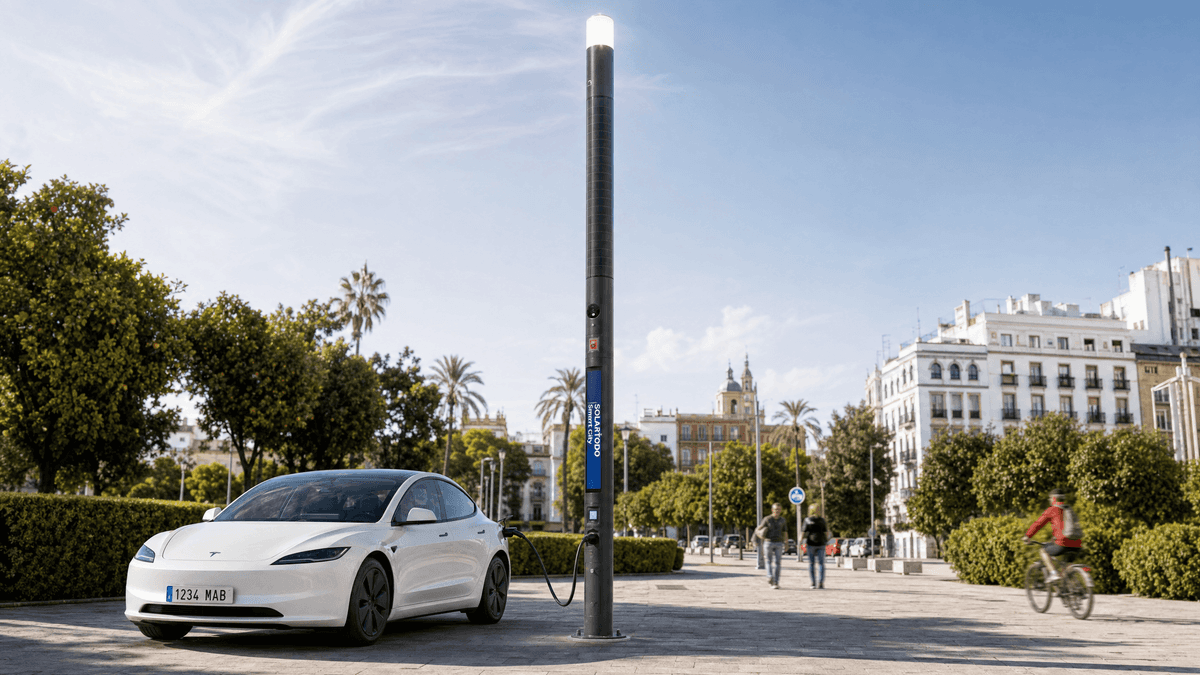
Seville Smart Streetlight Technical Fit: 10m Ø219mm Flush-Integrated Pole Configuration Guide
Summary
Seville’s hot-summer climate, dense visitor flows, and public-realm digitization goals make a 10m smart streetlight class practical for urban corridors. A typical 105-unit layout at 25m spacing would cover about 2.6km, using 60W/9000lm luminaires, embedded 11kW AC charging, and ~200W CIGS wraparound solar support.
Key Takeaways
- A typical Seville corridor deployment would use approximately 105 units at 25m spacing, covering about 2.6km of urban street frontage rather than highway or park applications.
- The recommended form factor is the SOLAR TODO 10m seamless cylindrical Ø219mm pole with 5mm wall thickness, because Seville’s central streets need compact street furniture and minimal visual clutter.
- Each pole would combine a 60W, 9000lm, 4000K multi-ring glow luminaire with a flush 8MP 180° fisheye camera, 4-parameter environmental sensing, and embedded WiFi 6.
- The solar package is approximately 200W of CIGS thin-film wrapped around 6.5m-9.3m of the pole body, backed by a 1,800Wh LFP battery and MPPT controller inside the base.
- EV charging is specified as a fully flush 11kW AC Type 2 charger with a 5m coiled cable, maintaining a constant Ø219mm cylinder with no widened base or separate bollard.
- According to Eurostat (2024), Seville municipality has roughly 684,000 residents, and this density supports multifunction poles that combine lighting, connectivity, and curbside services in one asset.
- According to AEMET (2024), Seville records very high summer heat and strong solar resource conditions, which support supplemental pole-mounted generation but still favor grid-connected urban lighting design.
- SOLAR TODO’s Smart Streetlight configuration for this profile aligns with IEC 60598 and GB/T 37024, while the compact flush architecture reduces protrusions, vandalism points, and streetscape conflicts.
Market Context for Seville
Seville’s urban core supports a compact smart streetlight format because the city combines roughly 684,000 municipal residents with a dense metropolitan mobility pattern and high public-space use across historic and commercial corridors. According to Eurostat (2024), Seville remains one of Spain’s largest municipalities, and according to Spain’s National Statistics Institute INE (2024), the province and metro area continue to concentrate tourism, services, and commuter traffic that increase demand for lighting, safety, and digital public infrastructure.
Climate matters for pole selection in Seville because summer daytime temperatures frequently exceed 35°C, while annual solar irradiation is among the highest in continental Europe. According to AEMET (2024), Andalusia experiences prolonged summer heat events, and according to the European Commission’s PVGIS tool (2024), southern Spain typically delivers strong solar yield conditions above most northern EU cities. That combination supports hybrid auxiliary power functions such as sensor, display, and communications backup, but it does not eliminate the need for stable grid-connected lighting in dense streets.
Seville also has a policy context that favors multifunction street assets rather than single-purpose poles. According to the Ayuntamiento de Sevilla’s urban sustainability and smart-city planning documents (2023), priorities include public lighting efficiency, digital services, sustainable mobility, and improved environmental monitoring. According to IDAE, Spain’s Institute for Energy Diversification and Saving (2023), municipal lighting upgrades remain a major efficiency lever because LED conversion and control systems can materially cut electricity use and maintenance frequency.
For telecom and digital layer planning, a compact integrated pole is more suitable than a large octagonal modular mast in Seville’s central districts. According to the European Commission (2024), EU cities are increasing demand for urban connectivity, curbside electrification, and data-enabled public services. In practical terms, Seville’s pedestrian-heavy boulevards, mixed traffic streets, and heritage-sensitive zones favor a monolithic 10m cylinder with flush modules over poles with side arms, external cabinets, speaker columns, or bolt-on display boxes.
The recommended size class is therefore the premium urban smart streetlight category rather than a highway traffic pole or small garden light. A 10m pole fits city streets with 25m spacing and 30-50 poles per kilometer, matching the supplied project-specific configuration and the product line’s urban-street positioning. SOLAR TODO’s cylindrical Smart Streetlight is especially relevant where the municipality or EPC wants lighting, EV charging, WiFi, emergency call, environmental sensing, and display in one narrow footprint.
[IEC] states, "IEC 60598 specifies general requirements and tests for luminaires," which is directly relevant for municipal lighting procurement and conformity review. [IRENA] states, "Digitalization can improve the management and operation of distributed energy assets," a principle that also applies to sensor-equipped street infrastructure with local energy storage and remote monitoring.
Recommended Technical Configuration
A typical Seville deployment of this class would consist of approximately 105 smart streetlights over about 2.6km, using a 10m monolithic cylindrical pole at 25m spacing for dense urban corridors. This configuration fits commercial avenues, transit-adjacent streets, waterfront promenades, and civic districts where visual control and compact curb occupation matter.
The correct product variant for this city profile is the SOLAR TODO cylindrical Smart Streetlight based on the provided [V:cyl219] specification. The pole remains a constant Ø219mm from top to bottom, with no widened charger pedestal, no side-mounted control cabinet, and no luminaire outrigger. That matters in Seville because narrow sidewalks, café frontage, bicycle movement, and heritage views all penalize external appendages.
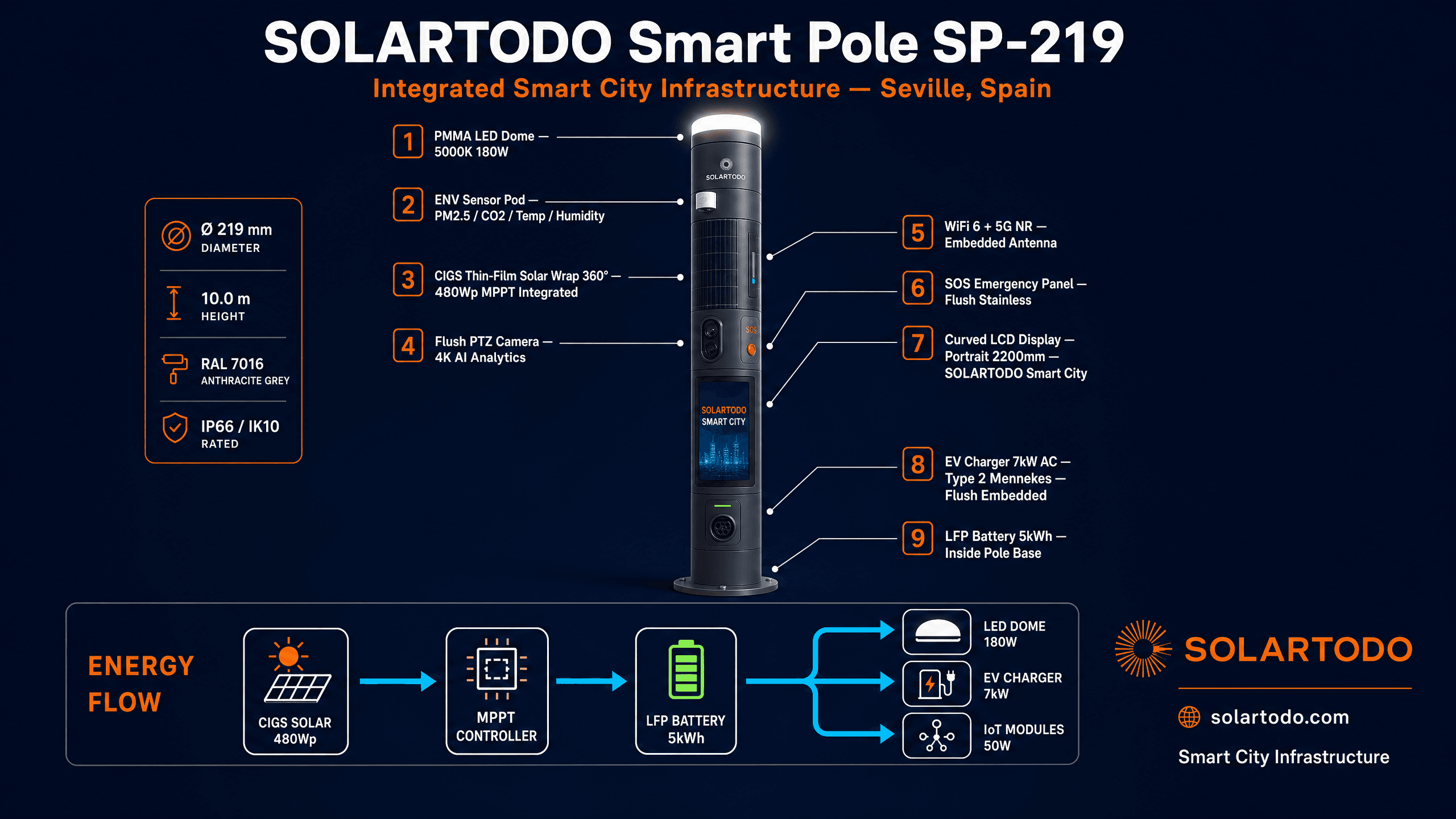
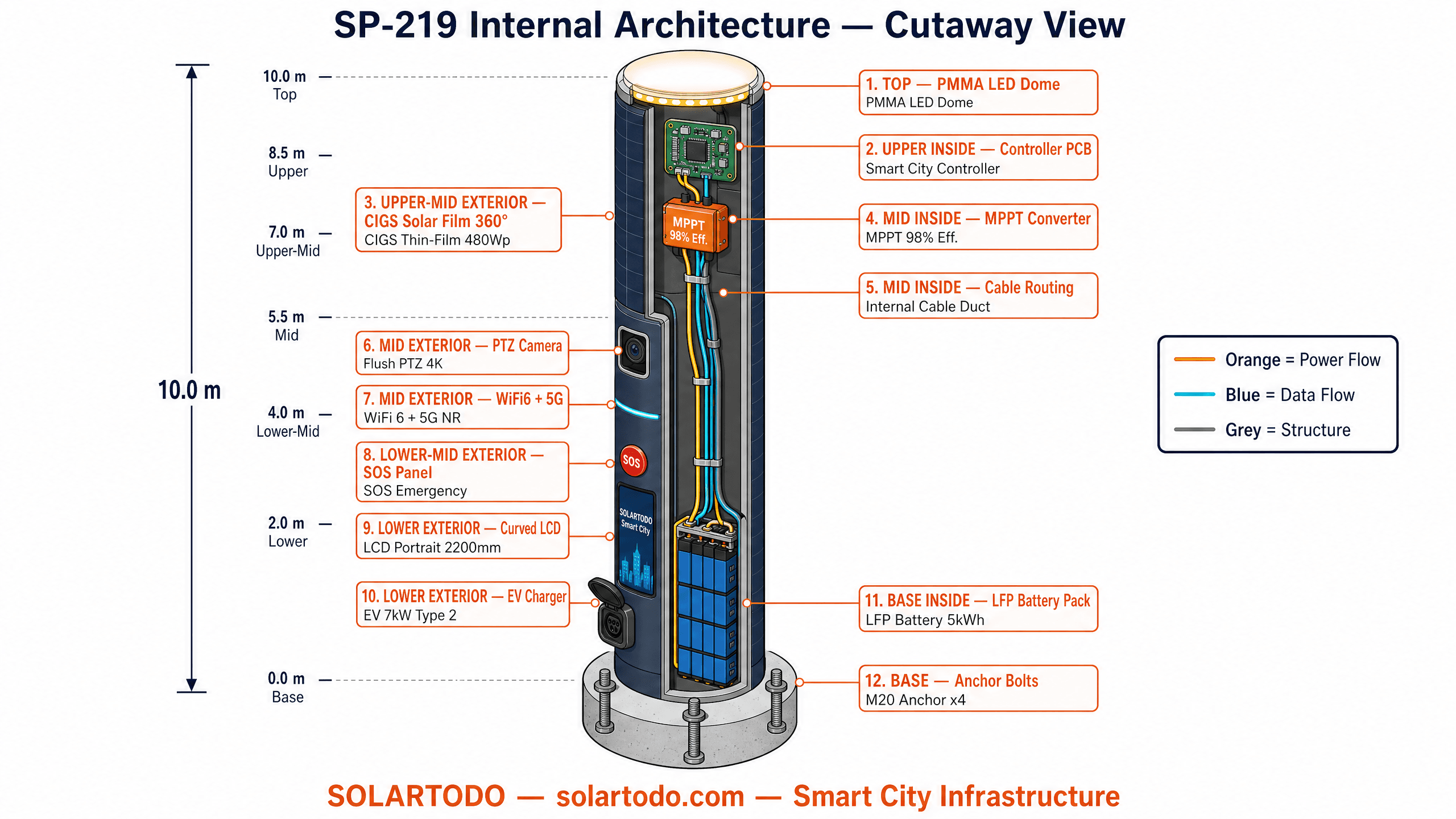
A typical 105-unit deployment in this profile would include lighting, public safety, connectivity, limited emergency response, and curbside charging in one structure. The recommended arrangement uses a 60W top luminaire delivering 9,000lm at 4000K, a flush 8MP fisheye camera under the dome, a 4-parameter environmental sensor, embedded WiFi 6, a flush SOS button with dual-way intercom, and a fully embedded 11kW AC Type 2 charger with 5m coiled cable. The display remains informational only: a 2200mm × ~170mm curved LCD inset, showing strictly “SOLARTODO Smart City” in white sans-serif on deep blue.
The energy architecture should be treated as grid-supported with solar-assisted auxiliary operation, not as a fully off-grid streetlight. The pole carries approximately 200W of CIGS thin-film wrapped around the mid-section from 6.5m to 9.3m, backed by a 1,800Wh LFP battery and MPPT controller in the base. In Seville’s irradiance conditions, this can support communications, sensing, interface loads, and resilience functions, while the main lighting and 11kW EV charging service should still be designed against municipal grid availability and local electrical code requirements.
From a streetscape perspective, the flush architecture is the main technical differentiator. No external WiFi disc, no protruding PTZ head, no speaker horn, and no side arm reduce both vandalism exposure and maintenance conflicts. For central Seville, that is a stronger fit than a modular octagonal pole with multiple bolt-on devices, especially on streets where urban design review is strict.
SOLAR TODO should therefore be positioned in Seville as a premium multifunction street asset for dense public-realm corridors, not as a generic light pole. For concept design, buyers can review the base product family at Smart Streetlight and request utility coordination or streetscape adaptation through contact us.
Technical Specifications
The recommended Seville configuration is a 10m Ø219mm seamless cylindrical smart streetlight with 105-unit typical scale, 25m spacing, and all modules flush-integrated into a single monolithic steel body. The specification below follows the provided [V:cyl219] requirements without adding external arms, boxes, or separate charging pedestals.
- Pole structure: 10m seamless cylindrical steel pole, constant Ø219mm top-to-bottom, 5mm wall thickness, hot-dip galvanized
- Finish: dark grey RAL7016 powder coating for lower visual contrast in urban commercial streets
- Form factor: one monolithic cylinder; no side arms, no luminaire outriggers, no external boxes, no speaker columns
- Luminaire: Ø219mm multi-ring glow column at top, 3-5 rings across top 1.5m, 60W, 9,000lm, 4000K
- Solar layer: CIGS flexible thin-film cells wrapped 360° around 6.5m-9.3m section, approximately 200W total, dark blue-black semi-transparent film, laminated flush to pole skin
- Battery system: 1,800Wh LFP battery inside pole base with MPPT charge control
- Camera: flush 180° panoramic fisheye camera, 8MP, mounted behind dome glass with no protrusion
- Environmental sensing: 4-parameter sensor pod on dome top for temperature, humidity, wind speed, and noise
- Communications: embedded WiFi 6 with internal antenna inside cylinder; no external antenna disc
- Emergency system: flush SOS button with dual-way audio intercom through pinhole speaker grille only
- EV charging: fully embedded 11kW AC charger, Type 2 socket with flush flip-cap, 5m coiled Type 2 cable, flush touchscreen at 1.5m height
- User charging extras: flush USB-A port plus Qi wireless charging pad
- Display: vertical curved LCD, 2200mm tall × ~170mm wide, bent to Ø219mm radius, flush inset on front face only
- Display content restriction: text-only “SOLARTODO Smart City,” stacked vertically, white sans-serif on deep blue, no ads, no video, no imagery
- Installation spacing: 25m typical, equal to about 40 poles per kilometer
- Standards: IEC 60598 and GB/T 37024
For Seville, this specification is best applied on urban collector streets, mixed-use boulevards, and civic corridors rather than expressways. According to IEC (2023), compliance with IEC 60598 is central to luminaire safety and testing. According to CENELEC and EU low-voltage practice, local installation design still requires Spain-specific electrical protection, earthing, and utility interconnection review at the EPC stage.
Implementation Approach
A 105-unit Seville smart streetlight rollout would typically be delivered in 5 phases over roughly 20-32 weeks, depending on civil permits, utility approvals, and streetscape constraints. The sequence should prioritize corridor surveys, power availability checks, and heritage-zone review before any fabrication release.
Phase 1 is corridor assessment and concept engineering, usually 3-5 weeks for a 2.6km route. This stage should verify sidewalk width, underground utilities, EV charging demand points, feeder distance, and lighting class requirements. In Seville, planners should also review tree canopy, tram or bus interfaces, and visual sensitivity in historic-adjacent districts.
Phase 2 is detailed design and procurement, usually 4-6 weeks once the pole schedule is frozen. This includes foundation drawings, cable routing, charger protection design, communications architecture, and content control for the curved LCD display. Because the pole is a constant Ø219mm cylinder, fabrication tolerances for flush-mounted openings matter more than on a standard octagonal pole with external cabinets.
Phase 3 is manufacturing, testing, and shipment, typically 6-10 weeks depending on quantity and inspection scope. Factory acceptance should verify galvanizing, coating adhesion, luminaire output, charger operation at 11kW AC, battery and MPPT function, display content lock, and ingress protection of all flush interfaces. For European projects, buyers often request pre-shipment photo records, electrical test reports, and packaging suitable for marine transit.
Phase 4 is civil works and pole installation, generally 4-8 weeks for about 105 units if lane access is controlled. Typical work includes foundation excavation, anchor setting or base preparation, feeder pull, earthing, pole erection, and charger energization. Because the design avoids side arms and separate EV pedestals, on-site assembly is simpler than multi-component smart pole systems.
Phase 5 is commissioning and acceptance, usually 2-3 weeks. This includes lighting aiming validation, although the top glow-column format minimizes directional adjustment, plus network registration, WiFi activation, camera privacy configuration, SOS call routing, charger testing, and display verification. SOLAR TODO buyers should also confirm maintenance access procedures for the embedded charger, battery, and internal electronics before final handover.
Expected Performance & ROI
A Seville smart streetlight program of approximately 105 units would primarily generate value through asset consolidation, lower lighting energy use, reduced street clutter, and new curbside service capacity. The direct economics are strongest when compared against older sodium or metal-halide lighting plus separate CCTV poles, WiFi points, emergency call boxes, signage, and standalone EV chargers.
According to the IEA (2022), LED lighting can reduce electricity consumption by 50% or more compared with conventional lighting technologies, depending on the baseline. According to IDAE (2023), Spanish municipal lighting upgrades often pair LED conversion with controls to reduce both energy and maintenance costs. In a Seville corridor replacing legacy 150W-250W conventional streetlights, a 60W/9000lm LED pole can materially cut lighting load while adding digital functions that would otherwise require separate powered assets.
The solar wrap and 1,800Wh LFP battery should be evaluated as resilience support rather than the main business case. According to NREL (2023), distributed battery-backed systems can improve service continuity for edge devices and communications during short interruptions. In practical terms, the ~200W CIGS layer can offset auxiliary loads such as sensing, control electronics, WiFi, standby display functions, and emergency interface availability, particularly in Seville’s high-irradiance climate.
EV charging economics depend on utilization, tariff structure, and parking policy, so payback should be modeled corridor by corridor. A flush 11kW AC Type 2 charger is suitable for destination charging where dwell times are 1-3 hours rather than rapid turnover. For municipal buyers, the stronger financial logic is usually combined value: one pole foundation, one grid connection point, one maintenance visit schedule, and one digital management layer for several public services.
A reasonable planning assumption for Seville is a simple payback window of about 6-10 years when replacing legacy lighting and eliminating multiple standalone street devices, though the exact result depends on charger utilization and civil scope. According to BloombergNEF (2024), urban EV charging demand continues to grow where curbside infrastructure is constrained, which supports integrated charger formats in dense city streets. For buyers comparing capex only, the key metric is not pole price per unit but total corridor cost per function delivered.
Comparison Table
A Seville buyer should compare the flush Ø219mm cylindrical pole against a conventional modular smart pole on total corridor function, not only on wattage or pole mass. The table below summarizes the practical fit for dense urban streets.
| Metric | SOLAR TODO Cylindrical Smart Streetlight (Recommended) | Conventional Modular Smart Pole |
|---|---|---|
| Pole height | 10m | 8-12m typical |
| Pole diameter/form | Constant Ø219mm cylinder | Octagonal/tapered, often wider base |
| Wall thickness | 5mm | Varies by design |
| Lighting output | 60W / 9,000lm / 4000K | 80-150W typical |
| Solar format | ~200W CIGS wraparound, flush | Often none or rigid panel brackets |
| Battery | 1,800Wh LFP internal | Optional, often external cabinet |
| Camera | Flush 8MP fisheye 180° | Often protruding dome/PTZ |
| WiFi | Embedded WiFi 6, internal antenna | External AP/disc common |
| Emergency interface | Flush SOS + pinhole audio | Surface box/intercom common |
| EV charging | Embedded 11kW AC Type 2 | Often separate pedestal or widened base |
| Street clutter impact | Low | Medium to high |
| Heritage-zone suitability | Higher | Lower |
| Typical spacing | 25m | 25-50m |
| Functions per foundation | 6+ | 3-6 |
Pricing & Quotation
SOLAR TODO offers three pricing tiers for this product line: FOB Supply (equipment ex-works China), CIF Delivered (including ocean freight and insurance), and EPC Turnkey (fully installed, commissioned, with 1-year warranty). Volume discounts are available for large-scale deployments. Configure your system online for an instant estimate, or request a custom quotation from our engineering team at [email protected].
Frequently Asked Questions
This FAQ answers 10 common Seville procurement questions covering 10m pole specs, 11kW charging, 25m spacing, maintenance, EPC scope, and expected ROI for urban smart streetlight projects.
Q1: Why is the 10m Ø219mm cylindrical pole recommended for Seville instead of a standard octagonal smart pole?
Seville has many dense urban corridors with narrow pedestrian zones, active retail frontage, and visual sensitivity near historic areas. A 10m constant-Ø219mm cylinder keeps all modules flush within one body, which reduces clutter and collision risk. For a 25m spacing plan, it also maintains a cleaner streetscape than poles with side arms, external boxes, or separate EV chargers.
Q2: Is this configuration fully off-grid because it includes solar film and a battery?
No. The recommended Seville configuration should be treated as grid-connected with solar-assisted auxiliary support. The ~200W CIGS film and 1,800Wh LFP battery can help power controls, sensors, communications, and resilience functions, but the 60W lighting load and especially the 11kW EV charger require grid-backed design for reliable urban service.
Q3: What lighting performance does each smart streetlight provide?
Each pole uses a top-mounted Ø219mm multi-ring glow luminaire rated at 60W and 9,000 lumens at 4000K. That output is suitable for city streets and mixed-use corridors rather than highways. Final pole spacing and photometric compliance should still be checked against the roadway width, mounting height, and local municipal lighting class.
Q4: How much street length would approximately 105 units cover in Seville?
At the specified 25m spacing, approximately 105 units would cover about 2,625m, or roughly 2.6km, of corridor length. Actual route coverage may vary slightly because intersections, curb cuts, bus stops, and utility conflicts can change exact pole placement. For budgeting, 40 poles per kilometer is a practical planning figure.
Q5: How does the embedded 11kW AC charger compare with a separate curbside charger pedestal?
The embedded charger saves curb space and avoids adding another foundation, bollard, and cabinet to the sidewalk. It is rated at 11kW AC with a Type 2 socket, 5m coiled cable, and flush touchscreen at 1.5m height. Separate pedestals may be easier to replace independently, but they usually increase streetscape clutter and civil cost.
Q6: What is a realistic implementation timeline for a 105-unit project?
A realistic program is about 20-32 weeks from survey to commissioning, assuming permits and utility approvals move normally. Concept engineering may take 3-5 weeks, detailed design 4-6 weeks, manufacturing 6-10 weeks, site works 4-8 weeks, and commissioning 2-3 weeks. Heritage review or feeder upgrades can extend this schedule.
Q7: What maintenance profile should buyers expect for this flush-integrated design?
Maintenance is usually lower on exposed accessories because there are fewer protruding parts to damage or vandalize. Routine work should include luminaire checks, charger testing, battery health review, cleaning of the dome sensor/camera window, and inspection of seals around the display and charging interface. A planned inspection cycle every 6-12 months is typical.
Q8: What ROI or payback range is reasonable for Seville?
For planning purposes, a combined-function payback of roughly 6-10 years is reasonable when replacing older lighting and avoiding separate CCTV, WiFi, SOS, signage, and charging assets. The exact payback depends on baseline energy use, civil scope, utility tariffs, and charger utilization. The strongest economics usually come from corridor-level asset consolidation rather than lighting savings alone.
Q9: What warranty structure is typical for this product line?
Warranty terms vary by quotation scope, but EPC turnkey offers typically include a 1-year installed-system warranty as stated in the pricing section. Buyers should also request component-level warranty details for the LED engine, charger, display, battery, and communications hardware. For municipal tenders, spare-parts availability over 3-5 years is also worth specifying.
Q10: What should EPC contractors verify before finalizing a Seville quotation?
EPC teams should verify feeder capacity, earthing design, charger protection requirements, sidewalk clearances, heritage-zone restrictions, and telecom backhaul assumptions. They should also confirm whether the display remains text-only as specified and whether privacy rules affect camera use. A corridor survey with utility mark-out is essential before foundation drawings are issued.
References
- Eurostat (2024): Municipal and urban population data for major EU cities, including Seville demographic scale relevant to public-infrastructure sizing.
- INE Spain (2024): Official population and territorial statistics for Seville and Andalusia used for urban demand context.
- AEMET (2024): Climate normals and extreme heat data for Andalusia, supporting high-temperature and high-irradiance design assumptions.
- European Commission PVGIS (2024): Solar resource data for southern Spain, supporting the use of supplemental CIGS generation on urban poles.
- IDAE (2023): Spanish municipal energy-efficiency guidance showing LED public-lighting upgrades as a major savings measure.
- IEC (2023): IEC 60598 luminaire safety and testing requirements applicable to street-lighting systems.
- IEA (2022): Energy efficiency and lighting transition analysis indicating LED systems can reduce electricity use by 50% or more versus conventional lighting.
- NREL (2023): Distributed energy and battery-backed edge-system guidance relevant to resilience benefits of local storage on smart infrastructure.
- BloombergNEF (2024): EV charging market outlook highlighting continued growth in urban charging demand and constrained curbside infrastructure.
- Ayuntamiento de Sevilla (2023): Local sustainability and smart-city planning documents covering public lighting, mobility, and digital public-space services.
Equipment Deployed
- 10m seamless cylindrical steel pole, constant Ø219mm, 5mm wall thickness, hot-dip galvanized
- Dark grey RAL7016 powder-coated finish
- Top multi-ring glow luminaire, 60W, 9000lm, 4000K
- CIGS flexible thin-film solar wrap, 360° around 6.5m-9.3m section, ~200W total
- LFP battery, 1800Wh, installed inside pole base with MPPT
- Flush 8MP fisheye 180° panoramic camera behind dome glass
- 4-parameter environmental sensor for temperature, humidity, wind speed, and noise
- Embedded WiFi 6 with internal antenna
- Flush SOS button with dual-way audio intercom through pinhole grille
- Embedded 11kW AC EV charger with Type 2 socket and 5m coiled cable
- Flush touchscreen at 1.5m height
- Vertical curved LCD display, 2200mm × ~170mm, text-only “SOLARTODO Smart City”
- Flush USB-A charging port
- Flush Qi wireless charging pad
- Standards compliance: IEC 60598 and GB/T 37024